
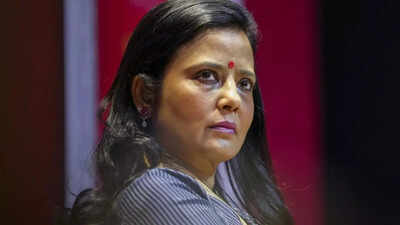
 Legal battle surrounding the cash-for-query allegations against Trinamool Congress parliamentarian Mahua Moitra has reached the Supreme Court after the country’s anti-corruption ombudsman challenged a Delhi High Court ruling that had set aside its decision allowing the Central Bureau of Investigation to file a chargesheet against her.
Lokpal of India approached the apex court seeking to overturn the High Court’s order, arguing that the judgment misinterpreted provisions of the Lokpal and Lokayuktas Act and could weaken the watchdog’s authority in corruption investigations involving senior public officials. The Supreme Court has agreed to examine the plea and issued notice to the parties involved, signalling that the dispute raises wider legal questions on how sanction for prosecution should be granted in cases investigated under the anti-graft law.
The controversy stems from allegations that Moitra asked parliamentary questions in exchange for cash and expensive gifts from businessman Darshan Hiranandani. The accusations first surfaced in 2023 when a complaint was filed by Bharatiya Janata Party parliamentarian Nishikant Dubey and advocate Jai Anant Dehadrai. They alleged that Moitra shared her Parliament login credentials with Hiranandani, allowing him to submit questions targeting specific corporate groups.
Moitra has acknowledged sharing her login credentials but denied receiving money or favours in return. She has repeatedly described the charges as politically motivated and has maintained that many parliamentarians allow staff or associates to assist in preparing parliamentary questions.
The Central Bureau of Investigation registered a case in March 2024 under the Prevention of Corruption Act after a reference from the Lokpal. The agency later submitted its investigation report to the anti-corruption body, seeking approval to proceed with filing a chargesheet against Moitra and Hiranandani.
Acting on that report, the Lokpal issued an order in November 2025 granting sanction to the CBI to file the chargesheet. Moitra challenged the decision in the Delhi High Court, arguing that the watchdog had failed to follow the procedure laid down under the Lokpal and Lokayuktas Act before granting approval.
A bench of the High Court set aside the sanction in December 2025, ruling that the Lokpal had departed from the statutory process. The judges observed that the procedure adopted by the anti-corruption body was inconsistent with the scheme and provisions of the law governing its functioning. They also held that the Act did not envisage separate sanctions for filing a chargesheet and for initiating prosecution.
According to the High Court’s interpretation, sanction under Section 20 of the Lokpal Act is intended as a single, composite approval for prosecution. The judgment said the Lokpal had erred by treating the sanction for filing a chargesheet as a distinct step from sanction for prosecution, a reading that the court found unsupported by the statute.
The ruling required the Lokpal to reconsider the question of sanction in accordance with the law, effectively halting the immediate filing of a chargesheet by the CBI.
The ombudsman has now asked the Supreme Court to review that interpretation, contending that the High Court’s view restricts the operational framework of the Lokpal. During the initial hearing, the bench headed by Chief Justice Surya Kant indicated that the issue involves a closer examination of the interaction between different subsections of Section 20 of the Act, which governs investigation and prosecution procedures.
The Supreme Court has also clarified that the Lokpal does not have to comply with certain directions issued by the High Court while the appeal is pending, effectively putting those directions on hold until the legal questions are settled.
The dispute highlights an important procedural issue in anti-corruption law: how sanction for prosecution should be structured when the Lokpal supervises an investigation conducted by the CBI. The ombudsman’s petition argues that interpreting the law as requiring only a single sanction stage could constrain its ability to oversee investigations and ensure accountability in cases involving elected representatives.
For Moitra, the legal proceedings form part of a broader political controversy that has unfolded since the allegations surfaced. In December 2023, the Lok Sabha voted to expel her following a recommendation from its ethics committee, which concluded that she had engaged in conduct unbecoming of a member of Parliament.
The ethics panel found that Moitra had shared her parliamentary login credentials with Hiranandani and received benefits, though she has consistently disputed the findings. Her expulsion triggered intense debate across political circles, with opposition parties accusing the government of targeting critics while supporters of the action argued that parliamentary standards had to be enforced.
Separate from the parliamentary action, the criminal investigation has continued under the supervision of the Lokpal and the CBI. The case illustrates the complex overlap between parliamentary ethics proceedings, criminal law and anti-corruption oversight mechanisms in the country’s governance framework.
Legal experts note that the Supreme Court’s interpretation of the Lokpal Act could shape future corruption investigations involving public officials. The outcome may determine whether sanction for prosecution must follow a single composite approval or can occur in stages linked to investigative and prosecutorial decisions.