
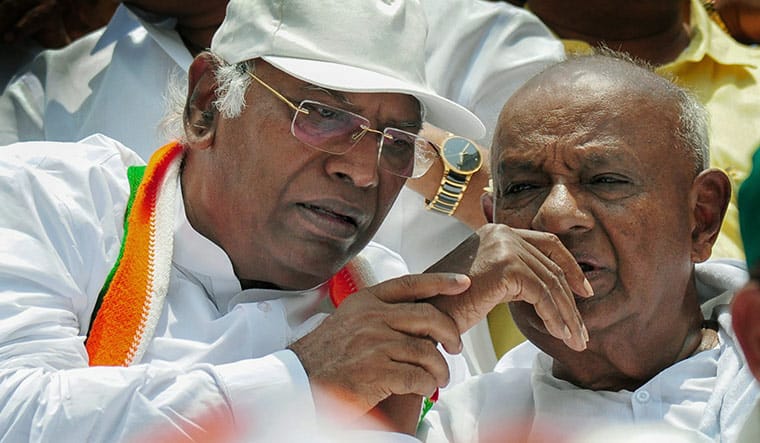
 Former Prime Minister H D Deve Gowda has sharpened his political rhetoric against Congress president Mallikarjun Kharge, rejecting remarks made in the Rajya Sabha that likened his party’s alliances to a personal relationship, and countering that his past association with Congress was a “forced marriage” that turned “abusive”.
The exchange unfolded during a heated parliamentary debate where Kharge, a senior Congress leader, used metaphor to question the Janata Dal chief’s shifting political alignments. Kharge said Deve Gowda had once “dated” Congress but ultimately “married” Prime Minister Narendra Modi, drawing laughter and interruptions in the Upper House. The comment was widely interpreted as a swipe at the JD decision to align with the Bharatiya Janata Party in Karnataka after years of rivalry.
Deve Gowda, responding outside Parliament and through party channels, rejected the framing and said his party’s past cooperation with Congress had been marked by compulsion rather than choice. He described the earlier alliance as one driven by circumstances that did not allow JD to operate independently, and said the partnership deteriorated into what he termed an “abusive relationship”, forcing a political “divorce”.
The remarks highlight intensifying friction between Congress and JD, particularly in Karnataka, where shifting alliances have shaped electoral outcomes over the past decade. JD, once positioned as a regional kingmaker, has alternated between partnerships with both national parties, often citing the need to secure stability or influence governance.
Kharge’s comments appear to have been aimed at portraying JD as politically inconsistent, especially after its alignment with BJP ahead of key electoral contests. Congress leaders have argued that the move contradicts JD’s earlier stance of opposing BJP’s policies, while JD maintains that alliances are dictated by pragmatic considerations and the need to represent its voter base effectively.
Deve Gowda’s rebuttal underscores a broader narrative that JD has sought to build in Karnataka: that its ties with Congress were uneasy and marked by unequal power dynamics. Party leaders have frequently pointed to the collapse of the Congress-JD coalition government in 2019, when defections led to the fall of the administration headed by H D Kumaraswamy, Deve Gowda’s son. JD has since argued that Congress failed to provide consistent support during that period, contributing to instability.
The rhetorical exchange also reflects the high stakes in Karnataka’s political landscape, where regional parties continue to play a critical role despite the dominance of national formations. JD retains pockets of influence, particularly in southern districts, and its alliance choices can significantly impact electoral arithmetic.
Congress, meanwhile, has sought to consolidate its position following electoral gains, portraying itself as the principal challenger to BJP. Kharge’s remarks can be seen as part of a broader strategy to question the credibility of smaller parties aligning with BJP, while also attempting to retain JD’s traditional voter base.
Political analysts note that the use of personal metaphors in parliamentary debates is not uncommon, but such remarks often resonate beyond the legislature, shaping public perception. In this case, the analogy of relationships has amplified the underlying political message, making it more accessible to a wider audience.
Deve Gowda’s characterisation of the alliance as “forced” and “abusive” adds a sharper edge to the discourse, signalling that JD intends to draw a clear distinction between its past and present alignments. The language suggests an effort to justify its current partnership with BJP while distancing itself from previous arrangements.
The episode also highlights generational and ideological contrasts within Karnataka politics. Deve Gowda, a veteran leader with decades of experience, continues to wield influence within JD, while Kharge represents Congress at the national level with deep roots in state politics. Their exchange reflects not only party positions but also personal political legacies.
Observers point out that such verbal sparring often serves to energise party cadres and frame narratives ahead of elections. For JD, emphasising grievances from its time with Congress may help consolidate its base and counter criticism over its alliance with BJP. For Congress, questioning JD’s consistency aims to weaken its appeal among voters seeking stable governance.