
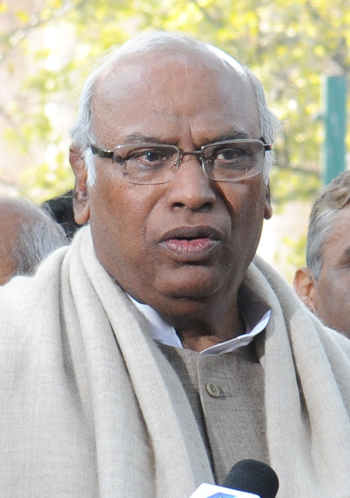
 Leader of the Opposition in the Rajya Sabha and Congress president Mallikarjun Kharge has alleged that a substantial portion of his speech during the Motion of Thanks to the President’s Address on 4 February was removed from the official parliamentary record without adequate justification, triggering a fresh confrontation between the government and the opposition over the functioning of the Upper House.
Kharge said that remarks he delivered in the course of criticising the government’s economic management, its handling of federal relations and issues of social justice were either deleted or not reflected fully in the published proceedings. He described the move as an erosion of parliamentary convention and an attempt to curb dissent within the chamber. According to him, the deletions went beyond established norms that allow the Chair to expunge words deemed defamatory, unparliamentary or unrelated to the debate.
The Motion of Thanks is a key parliamentary exercise that follows the President’s Address at the start of the Budget Session. It provides members across party lines an opportunity to debate the government’s policy direction and legislative priorities. Kharge, speaking as Leader of the Opposition in the Upper House, had used the debate to question the government’s claims on employment generation, inflation control and institutional autonomy, while also raising concerns over what he termed the shrinking space for opposition voices.
Under the Rules of Procedure and Conduct of Business in the Council of States, the Presiding Officer has the authority to order that words or expressions be expunged if considered defamatory, indecent, unparliamentary or undignified. Such decisions are traditionally recorded in the proceedings with a note indicating that certain portions have been expunged. Parliamentary experts note that while expunction is not uncommon, disputes often arise when opposition leaders believe substantive political criticism has been removed.
Kharge argued that his speech fell squarely within the framework of legitimate political debate. He maintained that his remarks were supported by data placed in the public domain and were directed at policy decisions rather than individuals. The deletions, he said, undermined the right of members to hold the executive accountable. He also indicated that the matter would be raised formally with the Chair, seeking clarity on the grounds for the action.
Government representatives have defended the authority of the Presiding Officer, stressing that parliamentary rules empower the Chair to maintain decorum and ensure that debates adhere to established standards. They contend that expunction is a procedural matter guided by precedent and not a tool aimed at silencing specific individuals. Officials point out that similar steps have been taken in the past against members across party lines when remarks were deemed inappropriate.
The episode has revived a broader debate about the tenor of parliamentary proceedings in recent years. Data compiled by legislative research groups show a rise in disruptions and adjournments in both Houses, often linked to high-stakes political issues. Opposition parties have frequently alleged that critical interventions are curtailed or not given adequate time, while the government maintains that it has adhered to procedural fairness.
Kharge’s allegation comes at a politically sensitive moment, as the Budget Session sets the tone for legislative priorities in the months ahead. The Congress leader has been central to coordinating opposition strategy in the Upper House, where the government does not command an outright majority. His interventions during debates have focused on unemployment figures, price stability, agrarian distress and questions surrounding federal fiscal transfers.
Parliamentary historians note that disputes over expunged remarks are not new. Instances in previous decades have seen members protest deletions, sometimes demanding that their full speeches be restored. The final authority, however, rests with the Chair, whose rulings are typically not subject to appeal within the House. Critics argue that greater transparency around the reasons for expunction could ease tensions and reinforce confidence in the process.
Legal scholars also underline that parliamentary privilege grants wide latitude to members to speak freely within the House, subject to internal rules. The balance between freedom of speech and maintenance of order is a delicate one, shaped by convention as much as by written procedure. Any perception that this balance has tilted disproportionately can fuel political friction.