
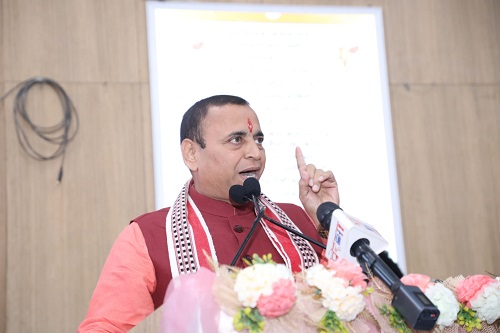
 Senior Bharatiya Janata Party leader Sunil Deodhar has apologised after comments he made at a political gathering in Meghalaya were widely criticised as mocking Christians and Jesus Christ, triggering protests, a police complaint and sharp reactions from opposition parties as well as members of his own organisation.
The controversy erupted after a video clip circulated on social media showed Deodhar addressing party workers during a visit to the hill state. In the footage, he appeared to make remarks that critics described as derisive towards Christian beliefs. Meghalaya has a predominantly Christian population, and the comments drew swift backlash from church groups, civil society organisations and political rivals who accused the leader of hurting religious sentiments.
Local Christian bodies condemned the remarks, stating that they were deeply offensive in a state where faith plays a central role in social and cultural life. Demonstrations were reported in parts of the state capital Shillong, with protestors demanding an unconditional apology and action against the leader. A complaint was lodged with the police alleging that the comments promoted disharmony and insulted religious beliefs.
Opposition leaders in Meghalaya and at the national level said the episode risked damaging communal harmony in a region that has historically been sensitive to identity and religious issues. They called on the Bharatiya Janata Party to clarify its position and to take disciplinary action. Some leaders argued that such remarks undermine efforts to expand the party’s footprint in the North East, where it has sought to balance its ideological base with local realities.
Deodhar, who has played a prominent role in the party’s organisational expansion in several states, issued a public apology after the video gained traction. In a statement, he said his words had been misinterpreted and that he did not intend to insult any religion. He expressed regret if his comments had hurt sentiments and reaffirmed his respect for all faiths. The apology followed mounting pressure, including reported internal unease within sections of the party over the political fallout.
Party functionaries in Meghalaya sought to contain the situation, emphasising that the organisation respects all religions and values social harmony. Leaders in the state unit distanced themselves from the controversial remarks and underscored their commitment to maintaining peace. The party is part of the governing coalition in Meghalaya, where regional dynamics and religious demographics make communal sensitivity particularly acute.
Legal experts note that cases involving alleged insults to religion in India often invoke provisions of the Penal Code dealing with promoting enmity between groups and outraging religious feelings. Police have said they are examining the complaint and the contents of the video before deciding on further action. Such cases can take time to process, especially when intent and context are disputed.
The episode has unfolded against a broader backdrop of heightened scrutiny over public speech by political leaders. Analysts point out that in states like Meghalaya, where more than 70 per cent of the population identifies as Christian according to Census data, political rhetoric touching on faith can carry significant consequences. Faith-based organisations hold considerable influence in public life, including education and social services, amplifying the impact of perceived slights.
Political observers say the controversy may test the party’s outreach strategy in the North East. Over the past decade, it has made electoral gains in several states in the region through alliances with local parties and by projecting development-focused governance. However, incidents perceived as insensitive to local religious sentiments can complicate those efforts and provide ammunition to rivals who question its inclusivity.
Within the party, there have been periodic instances where leaders’ comments on religious issues have drawn criticism and prompted clarifications or apologies. Senior figures have on multiple occasions reiterated the importance of disciplined communication, particularly in socially diverse regions. The leadership at the national level has often emphasised “sabka saath, sabka vikas” as a guiding principle, highlighting inclusive development.