
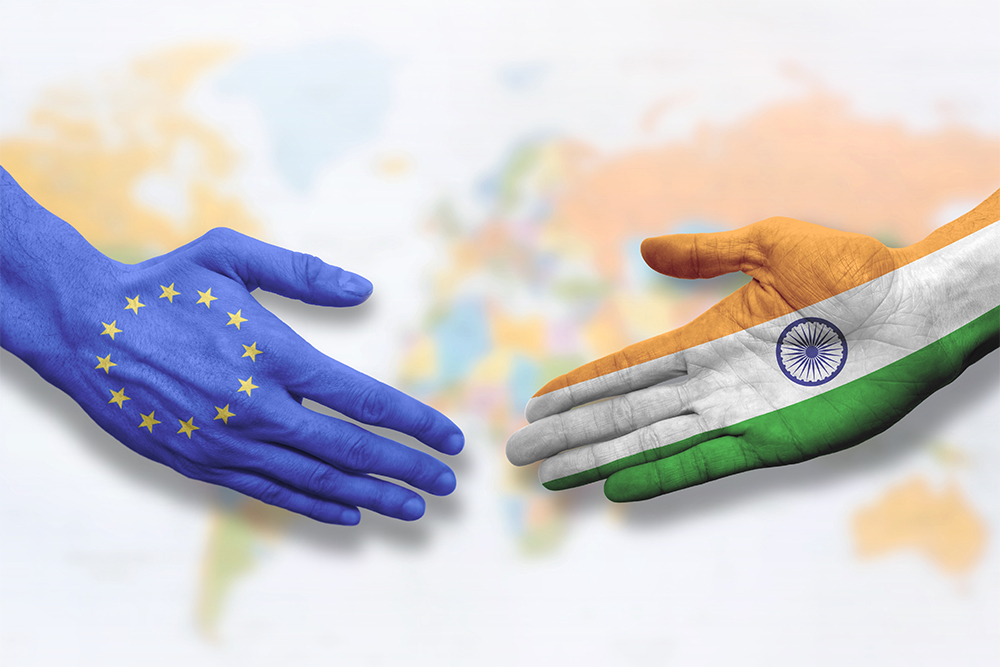
 Comments by Scott Bessent criticising Europe’s decision to finalise a sweeping trade agreement with India have sharpened an already tense debate over how Western economies balance commercial priorities with geopolitical commitments linked to the war in Ukraine.
Bessent, a prominent investor and economic commentator who has advised US policymakers in the past, argued on Wednesday that Europe’s move underscored a willingness to place trade interests above professed solidarity with Ukraine. His remarks, delivered in a public forum and circulated widely among policy circles, framed the agreement as evidence that economic pragmatism was overtaking moral positioning in European capitals.
The criticism landed as the European Union moves toward implementation of a long-negotiated free trade framework with India, a deal designed to expand market access across goods, services and digital trade while reducing tariffs and regulatory barriers. European officials have presented the agreement as central to diversifying supply chains away from China and strengthening engagement with fast-growing economies. India, for its part, has promoted the pact as a gateway for investment, technology transfer and exports, while preserving strategic autonomy in foreign policy.
Bessent’s intervention highlighted a persistent fault line in transatlantic discourse since Russia’s invasion of Ukraine. Washington has repeatedly urged allies to maintain economic pressure on Moscow and to avoid steps that could dilute the political message of unity behind Kyiv. While Europe has imposed sanctions and provided military and financial support to Ukraine, it has also pursued trade and energy diversification to protect domestic economies from prolonged disruption.
European officials counter that the India agreement does not contradict support for Ukraine. They note that India’s neutral stance on the conflict has not prevented engagement by the United States or Europe in other strategic areas, including defence cooperation and technology partnerships. EU negotiators emphasise that the trade pact is grounded in long-term economic interests rather than short-term political signalling, arguing that growth and stability in Asia ultimately reinforce global resilience.
The deal with India carries significant economic weight. The EU remains one of India’s largest trading partners, with bilateral trade in goods and services running into hundreds of billions of euros annually. The agreement aims to deepen cooperation in pharmaceuticals, green technology, automotive manufacturing and digital services, sectors where European firms seek scale and Indian companies look for predictable access to advanced markets. Analysts say the pact could also accelerate regulatory alignment in areas such as data protection and intellectual property.
From Washington’s perspective, the timing has proved sensitive. The United States has sought to rally partners around a rules-based order that isolates Russia economically. Critics within US policy circles worry that high-profile trade deals with countries maintaining ties to Moscow could weaken leverage. Bessent’s comments echoed that concern, suggesting Europe was sending mixed signals by championing Ukrainian sovereignty while advancing a major commercial partnership with a state that has not joined sanctions on Russia.
European diplomats reject that interpretation, stressing that India’s role in global supply chains and its position as a large democracy make engagement unavoidable. They argue that isolating India would be counterproductive and that sustained economic ties provide channels for dialogue on security and humanitarian issues. Some also point to Europe’s own economic pressures, including inflation and industrial competitiveness, as factors driving the push for new trade corridors.