
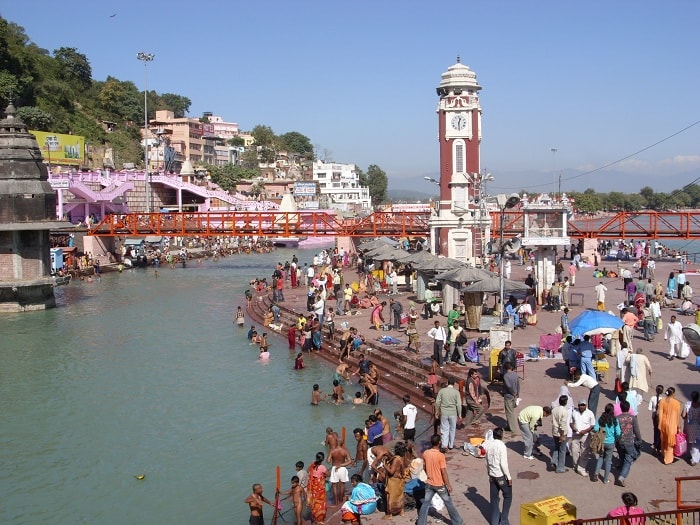
 A sharp political and social debate has unfolded in Uttarakhand after the Ganga Sabha, the traditional body overseeing rituals at Haridwar’s sacred riverfront, called for a blanket prohibition on non-Hindus entering the Ganga ghats, extending its demand to include government officials and journalists assigned to duties at the pilgrimage town.
The demand, articulated by senior members of the Sabha during meetings and public statements, asserts that access to the ghats should be restricted exclusively to Hindus, arguing that the riverfront is not merely a public space but a living religious site where rituals, customs and sanctity must be preserved without what it describes as external interference. Sabha representatives have further insisted that officials supervising events or maintaining law and order at the ghats, as well as media personnel covering religious gatherings, should also belong to the Hindu faith.
The declaration has drawn immediate attention because Haridwar, one of the four sites of the Kumbh Mela, operates under a complex legal and administrative framework where religious tradition, constitutional guarantees and civic governance intersect. The ghats, while revered, are also public spaces maintained by civic authorities and used daily by pilgrims, tourists and residents from varied backgrounds.
Call to restrict ghat access fuels nationwide debate has echoed across political circles, civil society groups and legal experts, many of whom warn that such a demand raises fundamental constitutional questions. Legal scholars point to guarantees of equality before the law and freedom of movement, noting that public spaces, even when religiously significant, cannot be regulated solely on the basis of faith unless supported by statute or judicial sanction.
Officials in the Uttarakhand administration have adopted a cautious tone. Senior bureaucrats have indicated that no decision has been taken to enforce the Sabha’s demands and that any policy affecting access to public areas would require careful legal examination. Security arrangements and administrative oversight at the ghats, they note, are governed by state law and long-standing practice, particularly during large religious gatherings where crowd management and safety are paramount.
Political responses have been divided. Leaders aligned with cultural and religious organisations sympathetic to the Sabha’s stance have argued that Hindu pilgrimage centres deserve protections similar to those observed at certain religious sites elsewhere, where entry is regulated by faith or gender. They contend that the demand reflects anxiety over erosion of tradition and growing commercialisation of sacred spaces.
Opposition parties and rights groups, however, have criticised the proposal as exclusionary and impractical. They argue that barring officials or journalists on the basis of religion undermines secular governance and press freedom. Media bodies have warned that such restrictions could obstruct independent reporting from major religious events that attract global attention and require transparent coverage, especially during festivals when public safety concerns are high.
The controversy has also sparked debate within Haridwar itself. Priests and local traders remain divided, with some backing the Sabha’s call as a means to safeguard ritual purity, while others fear it could harm the town’s economy, which relies heavily on pilgrims and visitors of diverse backgrounds. Residents note that Haridwar has historically accommodated people from across the country and abroad, including scholars, photographers and officials tasked with conservation of the river and heritage structures.
Environmental groups have entered the discussion as well, pointing out that river management, pollution control and conservation efforts often involve experts and officials from multiple institutions. They caution that restricting access based on religious identity could complicate ongoing programmes aimed at cleaning and preserving the Ganga, which require technical expertise and inter-agency coordination.