
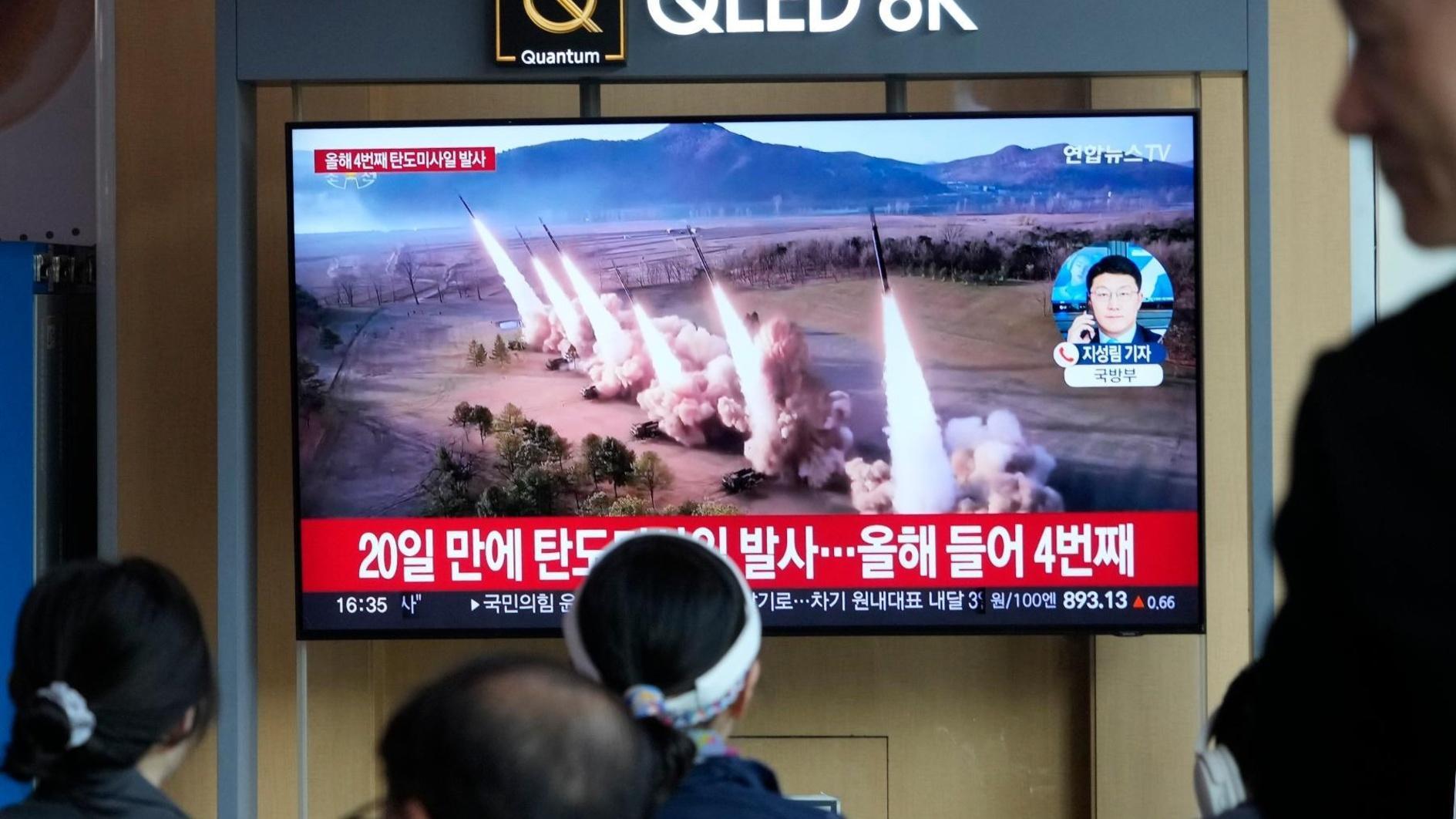
 North Korea fired multiple short-range ballistic missiles towards the East Sea on Wednesday in a fresh show of force that undercut South Korea’s effort to lower tensions, with Seoul’s military saying the weapons were launched from the Wonsan area and flew about 240 kilometres. A later projectile from the same area travelled about 700 kilometres, according to South Korea’s Joint Chiefs of Staff, extending a back-to-back sequence of launches after a suspected ballistic missile was also detected on Tuesday.
 The launches came only days after President Lee Jae Myung expressed regret over drone incursions into the North that he said were carried out by civilians acting against government policy. Lee said an investigation had found the involvement of a National Intelligence Service employee and an active-duty military official, and described the incidents as unconstitutional acts that had unnecessarily heightened military strain. Pyongyang initially reacted in unusually measured language, with Kim Yo Jong calling Lee’s remarks “very fortunate and wise”, a phrase that raised guarded hopes in Seoul that a narrow diplomatic opening might be emerging.
Those hopes were quickly checked. Reuters and other reports show that North Korea followed the conciliatory note with a harder line from senior foreign ministry official Jang Kum Chol, who said the South would remain the North’s “most hostile enemy state” regardless of rhetoric or conduct. Analysts cited in the same coverage said Pyongyang appeared to be drawing a firm boundary between tactical de-escalation and any broader shift in policy, signalling that it may accept a reduction in immediate friction while rejecting the idea of warmer inter-Korean relations.
South Korea’s military treated Wednesday’s launches as a clear provocation and said Seoul and Washington were conducting a detailed analysis. Japan also monitored the later launch, with Tokyo saying no missile entered its territorial waters or exclusive economic zone. The U. S. Indo-Pacific Command said the launches posed no immediate threat to U. S. personnel, territory or allies, but the episode reinforced concern in Seoul, Tokyo and Washington that North Korea is combining political messaging with a steady tempo of weapons testing.
The chronology matters. South Korea’s military said the Wednesday launches marked North Korea’s fourth, fifth and sixth ballistic missile events of the year, following two launches in January and another in March. That pattern suggests Pyongyang is maintaining a regular testing cycle rather than staging a one-off protest. It also comes as the North continues to refine systems that analysts believe are designed to make interception harder, especially solid-fuel weapons that can be moved faster, prepared more quickly and concealed more effectively than older liquid-fuel missiles.
A further layer was added on Thursday when North Korean state media said the country had tested a cluster-bomb warhead fitted to a tactical ballistic missile, alongside an electromagnetic weapon, carbon-fibre bombs and a mobile short-range anti-aircraft missile system. South Korean analysts quoted by Reuters said the disclosures pointed to a broader attempt by Pyongyang to display modern conventional war-fighting capability, not only nuclear deterrence. The reported Hwasongpho-11 Ka test, if accurately described, would indicate an effort to threaten wider-area targets and critical infrastructure with more varied payloads.
That matters strategically because North Korea’s missile programme is no longer judged only by range. Analysts have increasingly focused on manoeuvrability, survivability, launch readiness and payload diversity. Reuters cited expert assessments that Pyongyang may be learning from conflicts in Ukraine and the Middle East, where electronic disruption, infrastructure attacks and low-cost but hard-to-counter systems have taken on greater importance. South Korean specialists said such developments could complicate defence planning by forcing a broader response to threats against air assets, naval systems, power infrastructure and rear-area facilities.
For Lee, the missile launches are an early test of a presidency that has tried to reopen space for coexistence without loosening deterrence. His government described Pyongyang’s first response to the drone apology as meaningful progress, and pledged to refrain from hostile acts while pursuing peaceful coexistence. Yet the speed with which North Korea shifted back to military signalling suggests Seoul faces a familiar dilemma: gestures intended to stabilise the border can reduce immediate risk, but they do not by themselves change Pyongyang’s longer-term doctrine or its insistence that the two Koreas now stand as hostile states rather than partners in suspended reconciliation.