
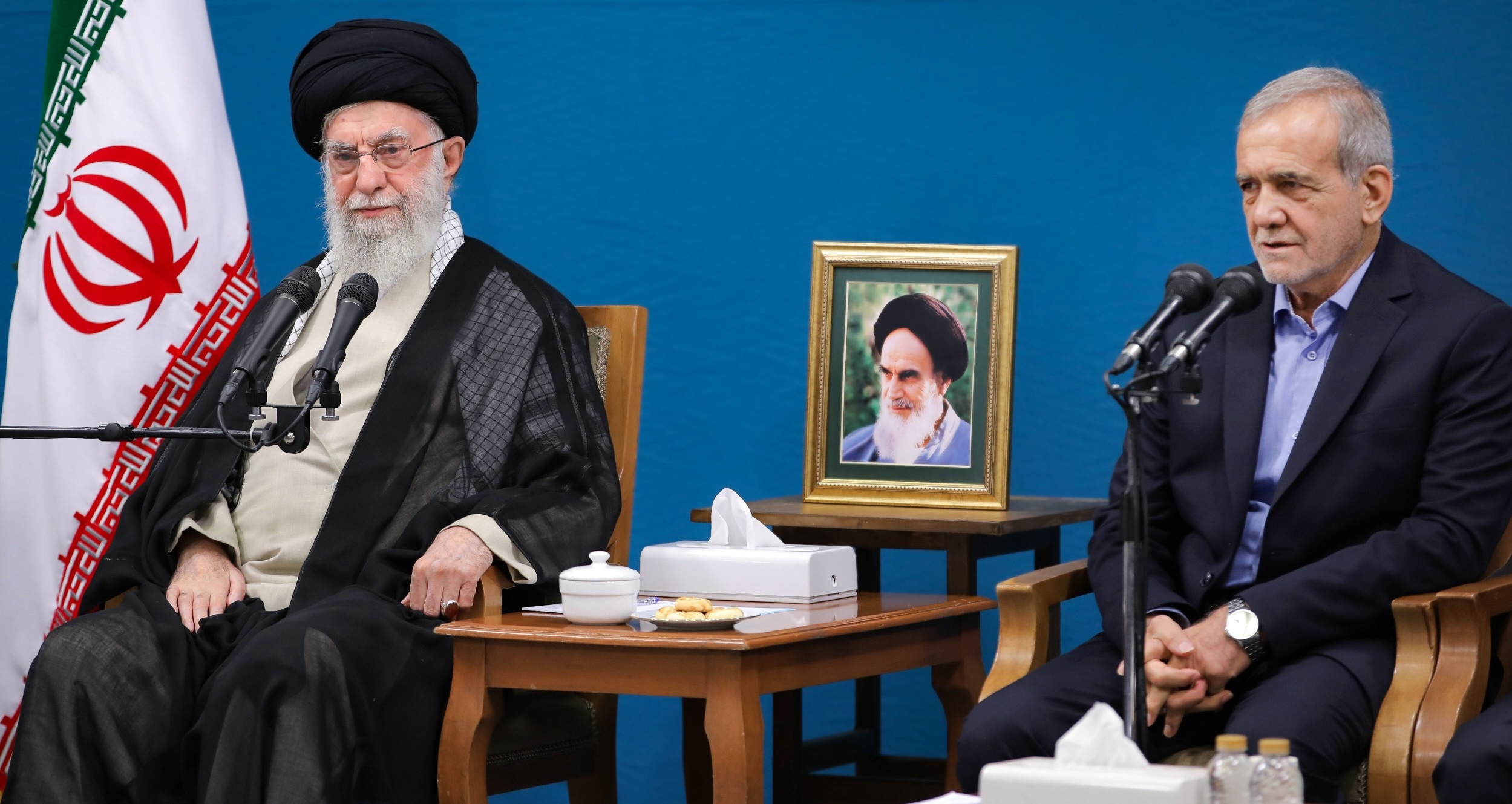
 A struggle between President Masoud Pezeshkian and the Islamic Revolutionary Guard Corps has sharpened into a new test of power inside Iran, with a report by Iran International saying the presidency has been pushed into “complete political deadlock” as the Guards block key appointments and decisions. The claim, which could not be independently verified, fits a broader pattern identified by Reuters over the past month: civilian authority in Tehran has weakened as the IRGC has assumed a more central role in strategy and state management during wartime turmoil.
 Iran International reported on April 1 that the Guards had effectively taken control of critical state functions, rejecting Pezeshkian’s proposed candidates for sensitive posts and surrounding the core of power with a security cordon. It said an attempt to appoint a new intelligence minister collapsed under pressure from IRGC commander Ahmad Vahidi. Those assertions come from unnamed sources speaking to an exile broadcaster based in London, so they require caution. Even so, Reuters has separately reported that the IRGC’s influence has expanded sharply since the war that began on February 28 and after the death of Ayatollah Ali Khamenei, with the corps seizing a bigger role in strategic decision-making.
That matters because Iran’s political system has always placed ultimate authority above the presidency, but the balance has moved further against elected institutions. Reuters reported on March 27 that Mojtaba Khamenei, who inherited the supreme leadership after his father’s death, holds sweeping formal powers but lacks the automatic authority that his father commanded and is seen as dependent on Guard backing. In that vacuum, the IRGC has become still more central, helped by a deep bench of commanders and a long-developed chain of replacements that has allowed it to absorb repeated battlefield losses without losing operational coherence.
Pezeshkian’s own difficulties were already visible well before the latest Iran International report. Reuters said on March 7 that he faced a backlash from Guards figures and hardliners after apologising to Gulf states for Iranian attacks on their territory and promising to restrain such strikes, forcing him into a partial retreat. That episode offered an early sign that the president, though still the most senior directly elected official in the country, could be overruled when his language collided with the priorities of the security establishment. Reuters later described the limits of his influence as having been “starkly illustrated” by that climbdown.
Events since then have only reinforced the sense that Pezeshkian’s room for manoeuvre is narrow. On April 1 he issued a public letter to Americans saying Iran bore no hostility towards ordinary citizens of the United States and calling for diplomacy, an effort that suggested he still wants to present a more pragmatic political face abroad. Yet Reuters’ reporting on the internal debate over Iran’s nuclear policy showed hardline voices gaining ground, with state media and figures tied to the Guards openly discussing withdrawal from the Nuclear Non-Proliferation Treaty and even the pursuit of a bomb. That divergence underscores a leadership split between those seeking rhetorical space for diplomacy and those arguing that the war has vindicated a more confrontational course.
The deeper issue is not simply a clash of personalities but the structure of the Islamic Republic itself. Iran’s system blends clerical oversight, elected offices and military-security institutions, yet in periods of extreme stress power tends to flow toward the actors who command force. Reuters quoted analyst Alex Vatanka as saying that wartime has clarified Iran’s power structure and that the decisive voice is no longer that of the civilian leadership but of the IRGC. That assessment aligns with the trajectory seen since late February, as the Guards, parliament speaker Mohammad Baqer Qalibaf and other hardline figures have emerged as more consequential players in public positioning and strategic direction than the president.
None of this means the presidency has become irrelevant. Pezeshkian still carries electoral legitimacy and remains an important public messenger, particularly to outside audiences and to factions inside the system that fear complete military predominance. But if the Iran International account is broadly accurate, the presidency now risks functioning more as a formal institution than an executive centre of power. Even where the details remain contested, the broader fact pattern is clearer: Iran’s civilian leadership has been squeezed by war, succession uncertainty and the consolidation of a Guard apparatus that has spent decades embedding itself across security, politics and the economy.