
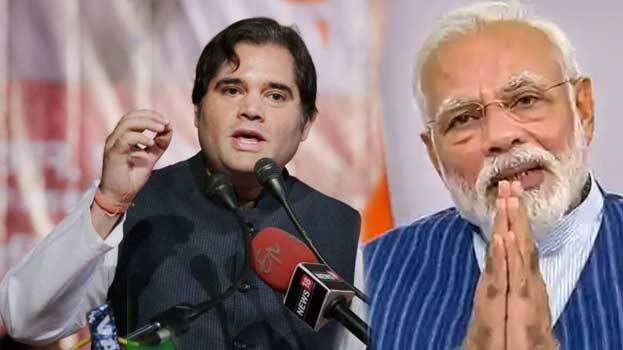
 Varun Gandhi’s meeting with Prime Minister Narendra Modi has triggered renewed speculation about his political future, with observers interpreting the interaction as a possible sign of reconciliation after a prolonged phase of estrangement from the Bharatiya Janata Party.
The former Member of Parliament, accompanied by his wife and daughter, met the prime minister on Tuesday, a development that quickly drew attention across political circles. The meeting, which came after years of visible distance from the party’s central leadership, has been viewed as a potential turning point in Gandhi’s relationship with the organisation that once positioned him as a rising figure.
Gandhi, son of Menaka Gandhi and the late Sanjay Gandhi, had gradually drifted away from the party’s mainstream over the past several years. His absence from key party platforms, combined with his outspoken positions on issues such as unemployment, agrarian distress and economic inequality, had set him apart from the official line. While he remained a member of the party, his political trajectory appeared increasingly uncertain.
The encounter with Modi has prompted speculation that the leadership may be open to reintegrating Gandhi into a more active role. Analysts suggest that the timing is significant, with political parties recalibrating strategies ahead of upcoming electoral contests in several states and at the national level. Re-engaging figures with a recognisable public profile could form part of a broader effort to consolidate support and present a unified front.
Gandhi’s political journey has been marked by both prominence and friction. Having entered public life with strong backing from within the party, he quickly gained attention for his speeches and organisational work, particularly in Uttar Pradesh. His electoral successes helped establish him as a significant presence, but his independent streak often placed him at odds with the party’s messaging.
Over time, his interventions on policy issues became more frequent and more pointed. Statements on farmers’ protests, economic policy and governance were seen by some within the party as diverging from the leadership’s stance. This led to speculation about his marginalisation, particularly as he was excluded from key committees and did not feature prominently in major campaign efforts.
Despite this, Gandhi maintained a consistent public engagement, using social media and public appearances to articulate his views. His approach drew a mixed response, with some observers praising his willingness to address contentious issues, while others questioned whether it undermined party cohesion.
The meeting with Modi is being interpreted through multiple lenses. Some political observers argue that it signals a pragmatic rapprochement, driven by mutual interests as electoral dynamics evolve. Others caution that a single meeting may not necessarily translate into a full political comeback, noting that internal party equations and strategic considerations will play a decisive role.
Within the broader political landscape, such developments are often shaped by a combination of personal rapport, organisational priorities and electoral calculations. Gandhi’s lineage, which connects him to one of the most prominent political families in the country, adds another layer of complexity to his positioning. While his association with the BJP has defined much of his career, his distinct identity has also set him apart.
For the party leadership, the potential reintegration of Gandhi could offer both opportunities and challenges. On one hand, his return to a more active role could help broaden the party’s appeal, particularly among segments that respond to his emphasis on socio-economic issues. On the other hand, managing differing viewpoints within a disciplined organisational structure would require careful calibration.
Gandhi’s supporters see the meeting as an indication that channels of communication remain open, suggesting that his period of relative isolation may be drawing to a close. Critics, however, point out that the absence of any formal announcement or defined role leaves room for uncertainty about the extent of any possible rapprochement.
Political analysts note that such engagements often carry symbolic significance, even in the absence of immediate outcomes. A meeting with the prime minister is rarely viewed as routine, particularly in the context of a leader whose relationship with the party has been under scrutiny. The optics alone can influence perceptions, both within the party and among the public.