
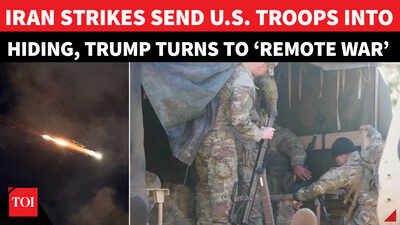
 Sustained missile and drone strikes attributed to Iran have rendered parts of several American military installations across the Middle East largely unusable, prompting the relocation of personnel into temporary civilian spaces and reshaping operational dynamics for US forces in the region.
The disruption has affected a network of bases that underpin Washington’s military posture from the Gulf to the Levant, with repeated barrages targeting infrastructure, accommodation blocks and logistical hubs. Officials familiar with the situation describe damage severe enough to limit habitation in some compounds, forcing troops to disperse into hotels, rented offices and other improvised facilities while maintaining mission continuity.
Air operations have continued from intact runways and hardened installations, but the shift on the ground has introduced new layers of complexity. Personnel are operating in decentralised environments, relying heavily on secure communications and remote coordination to manage surveillance, targeting and support functions. The arrangement, described by defence analysts as a form of “remote warfare”, underscores how sustained low-intensity attacks can degrade conventional military basing without triggering full-scale conflict.
The pattern of strikes reflects a broader escalation in asymmetric tactics, with drones and precision-guided munitions enabling persistent pressure on fixed assets. Military planners have long considered such vulnerabilities, yet the current intensity has tested assumptions about resilience and redundancy. Bases designed to withstand isolated attacks are facing repeated hits, stretching repair cycles and complicating force protection measures.
US officials have not publicly detailed the full extent of damage, but regional commanders have acknowledged operational adjustments. Rotational deployments have been modified, with some units relocated to alternative facilities or neighbouring countries. Logistics chains have also been rerouted to avoid exposed nodes, adding cost and time to supply movements.
The attacks are widely viewed as part of a calibrated strategy by Tehran and aligned groups to challenge US presence without crossing thresholds that might provoke a direct confrontation. By targeting infrastructure rather than personnel at scale, the campaign seeks to impose operational strain while maintaining plausible deniability. Analysts note that such tactics mirror earlier episodes in Iraq and Syria, where militia groups used rockets and drones to harass coalition forces.
The impact extends beyond immediate military concerns. Host nations, many of which host US forces under bilateral agreements, are navigating the political and security implications of hosting installations under sustained attack. Governments in the Gulf and elsewhere have invested heavily in air defence systems, yet the proliferation of low-cost drones has exposed gaps in layered defences.
For Washington, the situation presents a strategic dilemma. Reinforcing bases with additional defensive systems risks further escalation, while scaling back presence could signal retreat and alter regional balances. Officials have emphasised that US forces remain committed to their missions, including counterterrorism operations and the protection of maritime routes, but the evolving threat environment is prompting reassessment of basing strategies.
Military experts highlight that dispersal and mobility are becoming central to force design. Instead of relying on large, fixed installations, future deployments may prioritise smaller, more agile footprints capable of shifting locations quickly. This approach, already under discussion in Pentagon planning circles, aligns with lessons drawn from conflicts where static targets have proven increasingly vulnerable.
The technological dimension of the attacks is also significant. Advances in drone capabilities, including extended range and improved accuracy, have lowered the barrier for sustained campaigns against high-value targets. Combined with intelligence support and coordination among allied groups, these systems enable persistent pressure without the need for conventional air power.
Within the affected bases, personnel have adapted to new routines. Command functions are being executed through distributed networks, with secure digital systems linking teams across multiple locations. Training and maintenance activities continue, albeit under constrained conditions, as units balance operational demands with safety considerations.
The broader regional context remains fluid, with tensions shaped by ongoing conflicts and shifting alliances. The targeting of US installations fits into a wider contest for influence, where state and non-state actors employ a mix of military and political tools to advance their interests. Observers note that the current phase illustrates how modern conflict increasingly blurs the line between front lines and rear areas.