
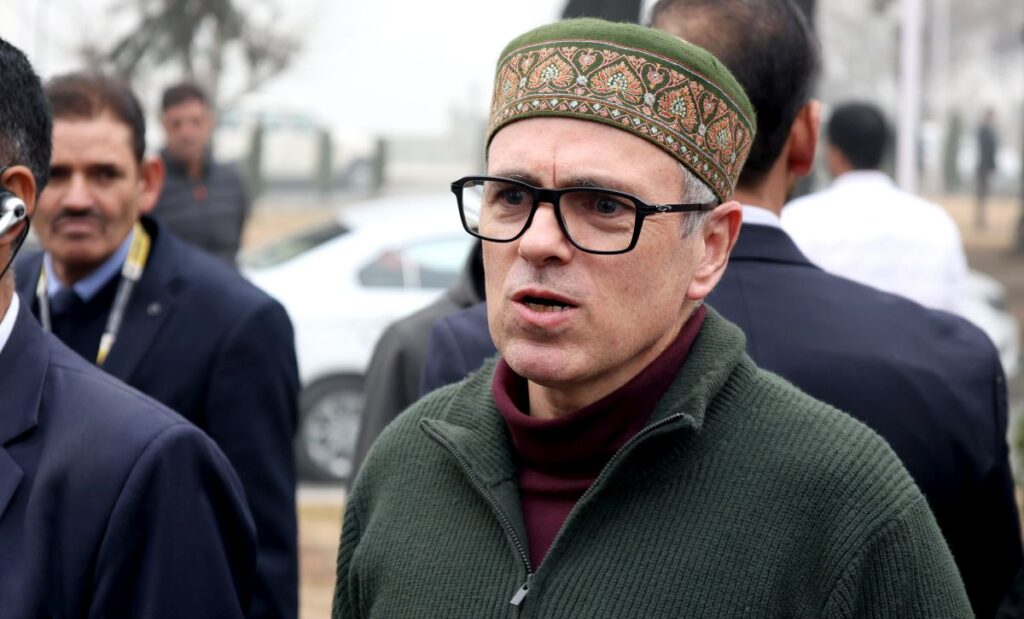
 Ruling National Conference MP Aga Ruhullah Mehdi has sharpened his criticism of Jammu and Kashmir Chief Minister Omar Abdullah, accusing him of failing to explicitly condemn the assassination of Iran’s Supreme Leader Ayatollah Ali Khamenei and urging a stronger political stand on an issue that has stirred emotions across the Valley.
The remarks, delivered on Monday, marked an escalation in what has become an unusually public disagreement within the National Conference, the party that returned to power in Jammu and Kashmir following the Assembly elections held after the restoration of limited statehood structures. Ruhullah, who represents Srinagar in the Lok Sabha, said that a general expression of concern over developments in West Asia was insufficient given the gravity of the killing and its resonance among sections of the population.
Ayatollah Ali Khamenei, who has served as Iran’s Supreme Leader since 1989, occupies a position of immense religious and political authority within the Islamic Republic. Any confirmed assassination of such a figure would represent a seismic shift in West Asian geopolitics, with implications for regional security, oil markets and global diplomacy. At the time of writing, Iranian state media had not issued formal confirmation of Khamenei’s death, and officials in Tehran had continued to broadcast footage of senior clerics and political figures without acknowledging such an event. International governments have also refrained from confirming reports circulating on social media, underscoring the sensitivity and uncertainty surrounding the claims.
Against that backdrop, Ruhullah’s intervention has injected a sharper tone into local politics. He argued that the Chief Minister’s statement, which conveyed concern over escalating tensions and appealed for peace, stopped short of naming the killing or condemning it outright. “A mere expression of concern does not address the moral and political dimensions of what has happened,” he said, calling for clarity from the government.
Omar Abdullah, who heads the National Conference and serves as Chief Minister, has positioned his administration as focused on governance, economic revival and institutional normalisation after years of political upheaval in the region. His public comments on international matters have tended to emphasise restraint and stability. Associates of the Chief Minister have indicated that foreign policy remains the prerogative of the Union government, and that state leaders must weigh their words carefully in a sensitive security environment.
The disagreement reflects broader currents within the Valley, where developments in West Asia often evoke strong reactions due to religious, cultural and historical affinities. Demonstrations in the past over events in Palestine, Iraq and Iran have drawn significant participation, and clerics have frequently addressed congregations on international affairs. Analysts note that leaders in Jammu and Kashmir must navigate these sentiments while operating within a constitutional framework that limits their authority over external relations.
Ruhullah, known for his outspoken positions, has at times taken stances that diverge from the cautious line adopted by sections of his party leadership. His comments on Khamenei add to a pattern of asserting an independent voice within the National Conference. Political observers see this as an attempt to consolidate support among constituents who expect unequivocal solidarity with figures perceived as symbolic of resistance in West Asia.
At the same time, the Chief Minister faces the challenge of balancing domestic governance priorities with volatile regional geopolitics. Tensions involving Iran have historically had ripple effects on global energy markets and diplomatic alignments. Any confirmed attack on Iran’s top leadership would likely intensify scrutiny from major powers and regional rivals, potentially affecting India’s strategic calculations, energy imports and diaspora interests in the Gulf.
Legal experts caution that statements by elected representatives can carry diplomatic implications, particularly in a region that has experienced prolonged security challenges. They argue that leaders must avoid inflaming passions or contributing to misinformation, especially when facts remain contested. Social media platforms have amplified unverified claims about the circumstances of Khamenei’s alleged killing, prompting calls for restraint and fact-based discourse.
Within the National Conference, senior figures have so far avoided direct rebuttals to Ruhullah’s remarks, suggesting that internal consultations may be under way. Party insiders describe a spectrum of views, ranging from those who favour a more forthright condemnation to others who stress adherence to constitutional boundaries and the need to prevent communal polarisation.
Opposition parties have seized on the exchange to question the coherence of the ruling formation. Some leaders have accused the National Conference of sending mixed signals at a time when governance and economic recovery require unified focus. Others have framed the debate as evidence of healthy democratic disagreement within a party.