
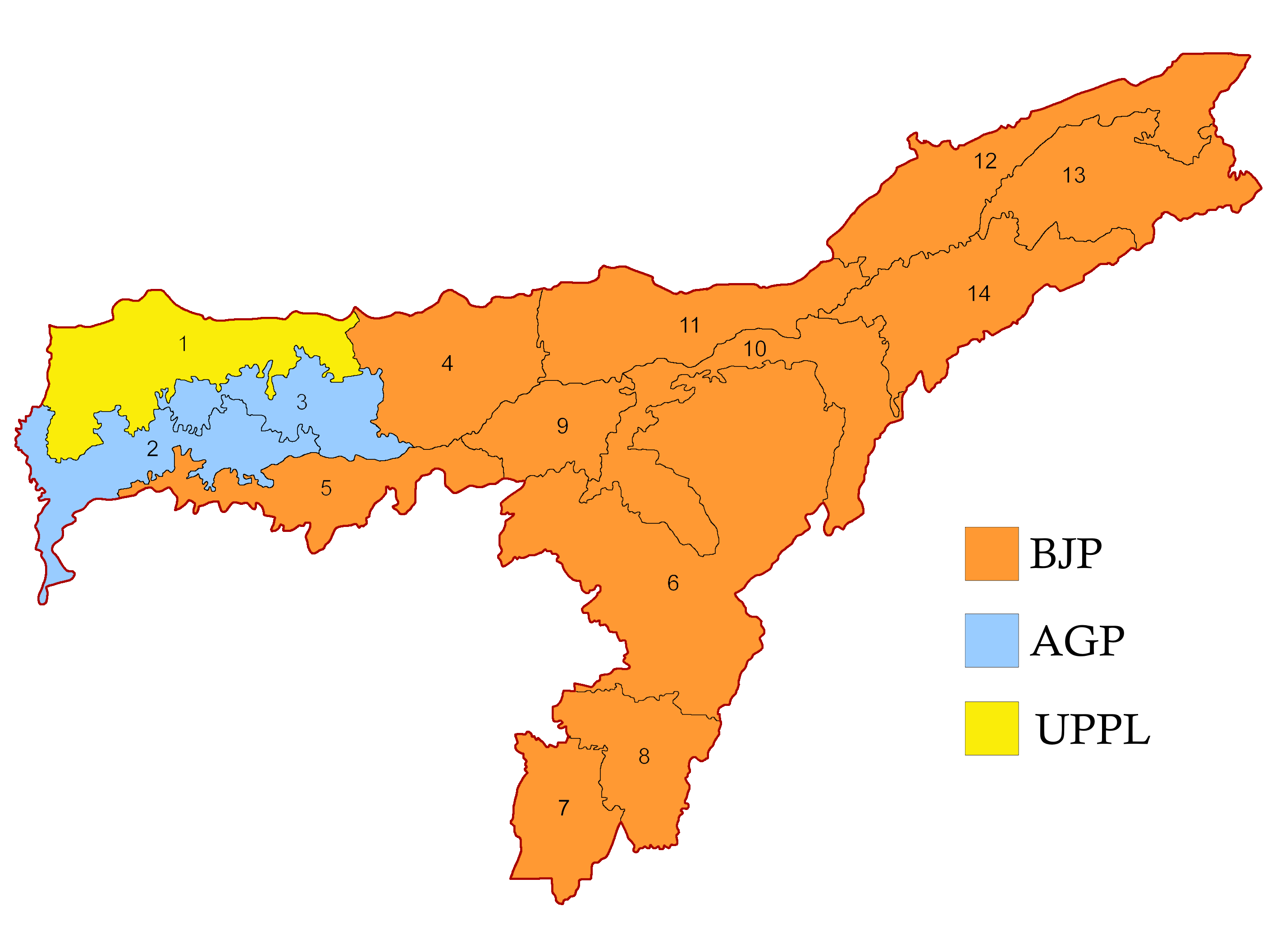
 Bharatiya Janata Party-led National Democratic Alliance is projected to secure a decisive majority in Assam’s upcoming Assembly election, with a pre-poll survey indicating a clear lead over the opposition INDIA bloc and suggesting a continuation of the ruling coalition’s dominance in the state.
The projection, based on a Vote Tracker survey conducted by VoteVibe, estimates that the NDA could win between 80 and 90 seats in the 126-member Assembly, comfortably surpassing the majority threshold of 64. The INDIA bloc, comprising several opposition parties attempting to consolidate anti-incumbency sentiment, is forecast to secure between 29 and 39 seats, pointing to a significant gap in electoral support.
Assam has remained a key political battleground in the northeast, where the BJP has expanded its footprint over the past decade through a combination of organisational strength, welfare outreach, and strategic alliances. The alliance’s current performance, as reflected in the survey, suggests that its governance record and electoral machinery continue to resonate with a broad cross-section of voters, particularly in rural constituencies and among first-time voters.
Chief Minister Himanta Biswa Sarma, who has emerged as a central figure in the region’s political landscape, is widely seen as a decisive factor in shaping voter sentiment. His administration has focused on infrastructure development, law and order, and targeted welfare schemes, all of which have been highlighted by the ruling coalition in its campaign messaging. The leadership’s emphasis on administrative efficiency and rapid execution of projects appears to have contributed to sustained voter confidence.
At the same time, the survey reflects the challenges faced by the INDIA bloc in presenting a unified and compelling alternative. While the alliance brings together parties with varied ideological positions and regional bases, internal coordination and leadership clarity remain areas of concern. Analysts note that fragmented messaging and limited grassroots mobilisation could be constraining the opposition’s ability to capitalise on local grievances.
Electoral trends in Assam have also been shaped by demographic and socio-political factors, including migration issues, identity politics, and regional development disparities. The BJP-led alliance has sought to address these concerns through a mix of policy measures and narrative-building, positioning itself as both a protector of regional identity and a driver of economic progress. This dual approach has been instrumental in consolidating its support base across different communities.
The opposition, for its part, has attempted to highlight issues such as unemployment, price pressures, and concerns over civil liberties, aiming to frame the election as a referendum on governance. However, translating these themes into electoral gains requires cohesive strategy and effective ground-level coordination, which the survey suggests may still be evolving.
Another factor influencing the electoral outlook is the role of smaller regional parties and independents, who can affect outcomes in closely contested constituencies. While the NDA’s projected seat share indicates a comfortable margin, local dynamics and candidate-specific factors could still shape individual seat results. Political observers caution that pre-poll surveys, while indicative of broader trends, are not definitive predictors of final outcomes.
Turnout patterns will also play a crucial role. Assam has historically recorded robust voter participation, and shifts in turnout among specific demographic groups can significantly alter electoral arithmetic. The ruling alliance’s ability to mobilise its base, combined with the opposition’s efforts to energise its supporters, will be closely watched as polling approaches.
The broader national context adds another layer to the contest, with Assam often seen as a barometer for political momentum in the northeast. A strong performance by the NDA would reinforce its position in the region and bolster its narrative of continued electoral success across multiple states. Conversely, any narrowing of the gap would offer the opposition an opportunity to recalibrate its strategy and build momentum for future contests.