
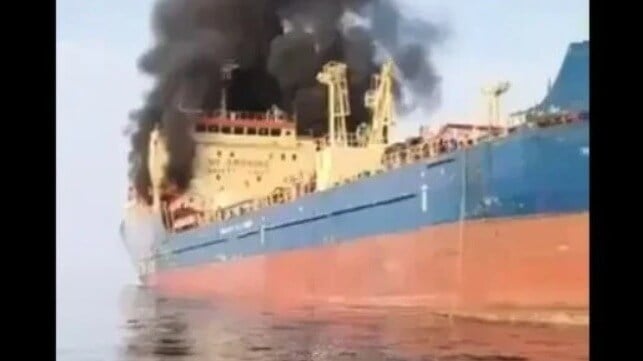
 Flames tore through a fully loaded Kuwaiti crude tanker anchored off Dubai on Tuesday after what Kuwaiti state media and multiple international reports described as an Iranian strike, marking another sharp escalation in the widening conflict that has pushed the Gulf’s commercial lifelines deeper into danger. The vessel, Al-Salmi, suffered hull damage and caught fire, though authorities later said the blaze was brought under control and no injuries were reported among the crew.
 The attack took place in the anchorage area off Dubai, with maritime reporting placing the incident roughly 31 nautical miles northwest of the city. Kuwait’s state news agency KUNA said the tanker was targeted while laden with crude, raising immediate concerns over both navigational security and the possibility of an oil spill. Dubai authorities said emergency teams contained the fire, while reports citing the vessel’s owner said damage assessments were under way.
Al-Salmi has now become the latest merchant vessel drawn into a conflict zone stretching far beyond military targets. Since the United States and Israel launched strikes on Iran on February 28, commercial shipping in and around the Strait of Hormuz has come under sustained pressure from missile, drone and projectile threats, insurance risks and intermittent closures. The waterway carries about a fifth of the world’s oil trade, making each fresh incident more than a local security matter.
Tuesday’s strike reinforced the sense that the Gulf’s energy infrastructure is no longer insulated from the battlefield. While the tanker was not reported sunk and no casualties were announced aboard, the symbolism was unmistakable: a large crude carrier associated with a Gulf producer was hit near one of the region’s busiest ports. That sends a message to shipowners, charterers and commodity traders already recalculating risk premiums on every voyage through Hormuz and nearby waters.
The incident also sharpened fears of environmental damage. Kuwait Petroleum Corporation was cited in multiple reports warning that a spill remained a possibility because of the hull damage. Even if no leakage is ultimately confirmed, the mere prospect of crude escaping from a fully loaded tanker near a major Gulf logistics hub underscores how a single attack can threaten trade, coastal operations and marine ecosystems at once.
For energy markets, the strike landed at a moment of extreme volatility. Reuters reported oil prices above $101 a barrel in the broader conflict environment, while other market coverage on Tuesday placed Brent above $107 and, at points, near $111 as traders weighed war risk against talk of diplomacy. The swings reflected a market struggling to price a conflict in which military escalation and political signalling now arrive almost hour by hour.
Diplomacy remains confused and contradictory. President Donald Trump has issued threats against Iran’s energy infrastructure while also signalling that he could support an end to the conflict even if Hormuz is not fully reopened immediately. Iran, meanwhile, has indicated that “non-hostile” shipping may transit the strait under certain conditions, yet attacks on commercial vessels have continued to cast doubt on how such assurances would work in practice.
The wider pattern is what most alarms maritime analysts. A limited number of ships have managed to move through Hormuz, including Chinese-operated container vessels and some tankers, but traffic remains constrained and highly selective. Operators have reportedly altered sailing patterns, reduced visibility where possible and weighed whether to risk transit at all. Each successful passage suggests the route is not fully shut; each strike suggests it is still far from secure.
For the Gulf states, the Al-Salmi strike is a reminder that geography can turn economic assets into front-line exposures with little warning. Dubai’s ports, Kuwait’s crude exports and the UAE’s wider role as a commercial hub all depend on confidence that tankers can anchor, load, unload and move without becoming proxies in a regional war. That confidence has been badly shaken, even where damage has been contained and casualties avoided.