
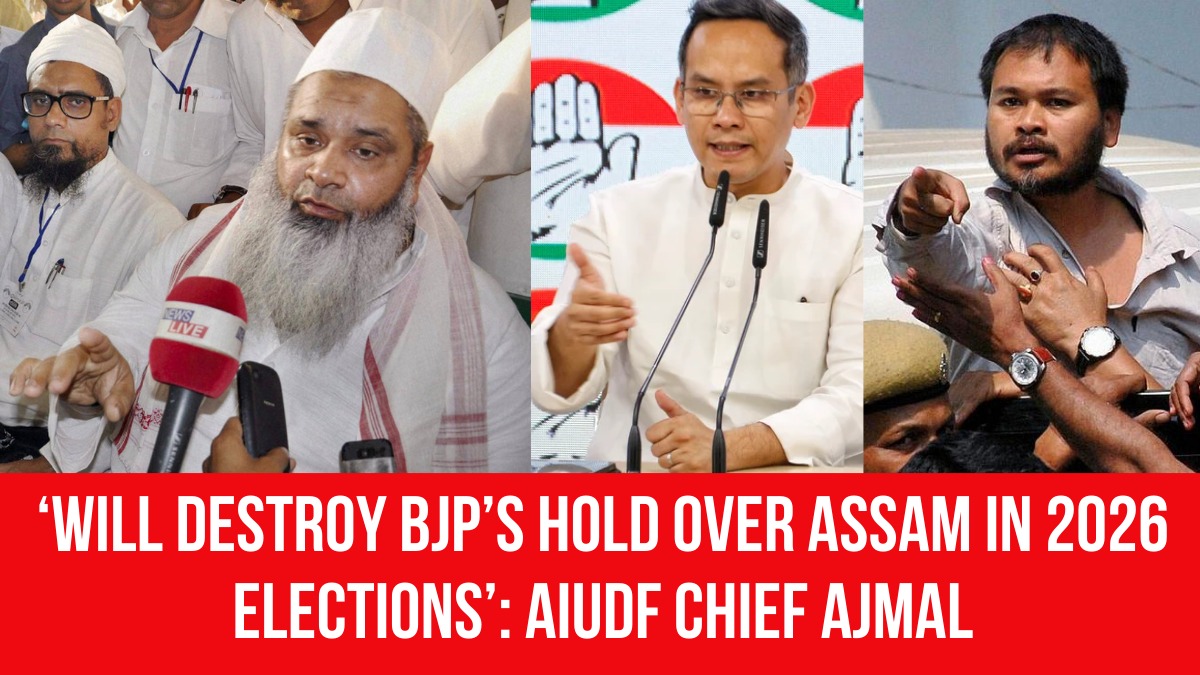
 All India United Democratic Front president Badruddin Ajmal has launched a pointed attack on the Indian National Congress, alleging that the party’s political conduct in Assam is indirectly helping the Bharatiya Janata Party consolidate its hold on power in the state.
Ajmal made the remarks on March 9 while addressing party workers and media, arguing that divisions among opposition forces have created favourable conditions for the BJP-led alliance. He claimed the Congress leadership had repeatedly failed to build a credible united front against the ruling party despite mounting pressure from opposition groups and sections of civil society.
According to Ajmal, fragmented electoral strategies and internal disputes among opposition parties have weakened resistance to the BJP in Assam. He contended that Congress leaders had prioritised organisational interests and local rivalries over the broader objective of challenging the BJP’s political dominance in the state.
Ajmal’s criticism reflects ongoing friction between the AIUDF and the Congress, which have alternated between cooperation and rivalry in Assam’s complex political landscape. The two parties had previously worked together as part of a broader opposition arrangement during earlier electoral contests. That alliance, however, collapsed amid disagreements over leadership, candidate selection and ideological positioning.
The AIUDF leader argued that the absence of a coordinated opposition strategy had allowed the BJP and its allies to maintain electoral advantages across multiple constituencies. He claimed that vote division among opposition parties had repeatedly helped the BJP secure victories even in areas where the ruling alliance faced strong local discontent.
Ajmal also questioned Congress’s political approach in minority-dominated constituencies, which have historically served as a key support base for both the AIUDF and the Congress. He suggested that competition between the two parties in these regions had led to vote fragmentation, ultimately strengthening the BJP’s prospects in multi-cornered contests.
Political observers have long noted that Assam’s electoral dynamics are shaped by a complex mix of regional identity issues, ethnic politics and religious demographics. The BJP expanded its political footprint in the state after forming government in 2016 and strengthening its position again during the 2021 Assembly elections through alliances with regional parties.
Ajmal’s remarks come at a time when opposition parties across the country have been debating the need for greater coordination against the BJP in state and national elections. The question of opposition unity has remained particularly contentious in Assam, where multiple parties compete for overlapping support bases.
Congress leaders in the state have rejected the allegation that the party is assisting the BJP indirectly. Party representatives argue that Congress continues to function as the principal opposition force and remains committed to challenging the BJP government through electoral and parliamentary means.
Congress figures have also accused the AIUDF of contributing to opposition fragmentation by pursuing an independent political path rather than working consistently with other parties. Some leaders have argued that Ajmal’s party has complicated efforts to build a cohesive opposition alliance by insisting on disproportionate influence in seat-sharing negotiations.
The rivalry between the AIUDF and the Congress reflects deeper strategic differences regarding how opposition politics should be conducted in Assam. Congress leaders generally seek to maintain a broad-based coalition that includes regional and community groups, while the AIUDF has focused heavily on consolidating support among minority communities, particularly in Lower Assam.
Ajmal’s criticism also highlights broader debates within opposition politics regarding the balance between ideological cooperation and electoral pragmatism. Analysts note that opposition parties across several states have struggled to reconcile local rivalries with the need for coordinated strategies against the BJP.
Assam’s political environment has undergone major transformation over the past decade. The BJP’s rise in the state was accompanied by alliances with regional parties such as the Asom Gana Parishad and the United People’s Party Liberal, allowing the ruling coalition to consolidate support across different ethnic and regional groups.
Opposition parties have attempted to challenge this alliance structure through various strategies, including regional coalitions and issue-based campaigns. Yet disagreements over leadership and ideological positioning have frequently hindered sustained cooperation.
Ajmal’s statements also underline the continuing importance of minority political mobilisation in Assam. The AIUDF was founded in 2005 and emerged as a significant political force in areas with substantial Muslim populations. Its electoral performance has fluctuated over the years, with the party gaining influence in certain constituencies while facing setbacks in others.