
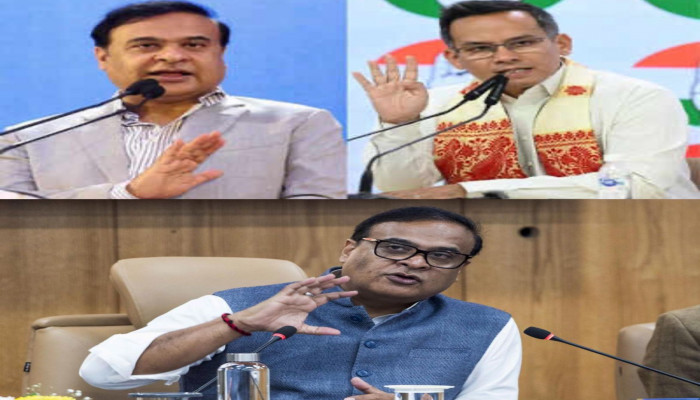
 Assam Chief Minister Himanta Biswa Sarma has initiated a ₹500 crore defamation suit against Congress leaders Gaurav Gogoi, Jitendra Singh and Bhupesh Baghel, accusing them of making allegations that he describes as false, malicious and defamatory.
The civil action, filed on Monday, marks a sharp escalation in the political confrontation between the Bharatiya Janata Party leadership in Assam and senior figures in the Congress. Sarma has maintained that the statements made by the three leaders were intended to tarnish his personal reputation and undermine his office, and has sought substantial monetary damages as a remedy.
According to details made public by his office, the lawsuit contends that the opposition leaders levelled accusations that lacked factual basis and were disseminated widely through press conferences and public remarks. Sarma has asserted that the allegations were calculated to create distrust among the public and damage his standing as head of the state government. The legal petition reportedly argues that such statements crossed the threshold of legitimate political criticism and entered the domain of actionable defamation under civil law.
Gaurav Gogoi, a Member of Parliament and a prominent Congress voice in Assam, has been at the forefront of opposition attacks on the state administration. Jitendra Singh, who has previously handled party responsibilities for the north-eastern region, and Bhupesh Baghel, the former chief minister of Chhattisgarh, have also criticised Sarma over various governance issues. The specifics of the allegations cited in the suit relate to remarks made in recent political exchanges, though the exact wording is expected to be examined in court proceedings.
Defamation cases between rival politicians are not uncommon in the country’s adversarial political landscape. Legal experts note that under civil law, a claimant must demonstrate that statements were published, referred to the claimant, and harmed reputation, and that they were not protected by defences such as truth, fair comment or privilege. The substantial quantum of damages sought in this instance underscores the seriousness with which Sarma views the alleged injury to his reputation.
Sarma, who has served as chief minister since May 2021, has emerged as one of the Bharatiya Janata Party’s most prominent figures in the north-east. His tenure has been marked by a strong political style and frequent verbal sparring with opposition leaders. The decision to pursue a ₹500 crore claim signals an intent to shift the dispute from the political arena into the judicial sphere, where evidentiary standards are more exacting.
Congress leaders have indicated that they stand by their statements, framing them as part of legitimate democratic scrutiny of those in power. Party functionaries argue that elected representatives have a duty to question and criticise government actions, particularly on matters of public interest. They are likely to contest the suit vigorously, potentially raising defences grounded in free speech and political accountability.
The case also highlights the increasing recourse to defamation litigation in high-profile political disputes. Over the past decade, courts have seen a steady stream of complaints filed by politicians across party lines, sometimes running parallel to criminal defamation proceedings. Civil suits seeking large sums in damages can have a chilling effect on political speech, critics argue, while supporters contend that public office does not strip an individual of the right to protect personal reputation.
Judicial precedents from the Supreme Court have upheld the constitutional validity of criminal defamation, while also emphasising the importance of balancing reputation with freedom of expression. In civil matters, courts assess whether statements were made with malice and whether they exceed permissible limits of political commentary. The outcome often depends on the precise language used and the context in which it was delivered.
Observers say the timing of the suit could have implications for the broader political climate. Assam remains a key state in the north-east, and political rhetoric tends to intensify ahead of major electoral cycles. Legal battles between senior leaders may further polarise party cadres and sharpen campaign narratives.