
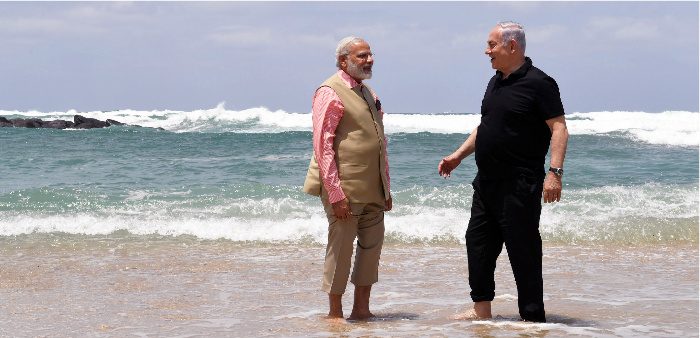
 Prime Minister Narendra Modi’s assertion that India recognised Israel on the day he was born has triggered a sharp political exchange, with the Congress citing archival correspondence between Jawaharlal Nehru and Albert Einstein to challenge what it called an attempt to personalise a complex diplomatic history.
Speaking during an address in the Knesset in Jerusalem, Modi noted that India formally recognised the State of Israel on 17 September 1950, which is also his date of birth. He described the coincidence as symbolic of the long-standing relationship between the two countries and pointed to the steady expansion of cooperation in defence, agriculture, water management and technology since the establishment of full diplomatic ties in 1992.
The comment quickly drew responses from the Congress, which said the recognition of Israel was the outcome of deliberations led by Nehru and reflected the geopolitical realities of the time rather than any personal milestone. Party leaders referred to exchanges between Nehru and Einstein in 1947, when the physicist appealed to India’s leadership to support the creation of a Jewish homeland. Nehru’s reply acknowledged Jewish suffering during the Holocaust but emphasised India’s support for a negotiated settlement that would avoid further communal division.
India voted against the United Nations Partition Plan for Palestine in November 1947 and opposed Israel’s admission to the UN in 1949, reflecting its broader non-aligned posture and concern for Arab opinion. Recognition of Israel followed in September 1950, although diplomatic relations were kept at a consular level until they were upgraded under Prime Minister P. V. Narasimha Rao in 1992.
Congress leaders argued that the episode underscored India’s historically calibrated approach to West Asia, balancing solidarity with the Palestinian cause alongside pragmatic engagement with Israel. They maintained that invoking a birth date risked oversimplifying a policy shaped by global pressures, domestic considerations and the emerging Cold War order.
The Bharatiya Janata Party defended the Prime Minister’s remarks, saying he had merely highlighted a historical fact while celebrating the transformation of bilateral ties over the past three decades. Since Modi’s first visit to Israel in 2017 — the first by a Prime Minister — cooperation has broadened significantly. Defence procurement, joint research in missile systems, and collaboration on cybersecurity and artificial intelligence have deepened, while trade has grown beyond traditional sectors such as diamonds.
Officials note that Israel has become one of India’s leading defence suppliers, with systems such as the Barak missile defence platform and surveillance equipment forming part of the security architecture. Agricultural cooperation centres across several states have introduced Israeli irrigation and horticulture techniques aimed at boosting yields in water-scarce regions.
At the same time, India has continued to voice support for a two-state solution in international forums and has provided development assistance to the Palestinian Authority. Diplomatic analysts observe that successive governments have sought to maintain strategic autonomy in West Asia, engaging multiple actors including Israel, Gulf states and Iran.
The debate also revived discussion of Nehru’s correspondence with Einstein, which historians view as emblematic of India’s early foreign policy dilemmas. Einstein, writing in June 1947, urged India to back Jewish statehood in the aftermath of wartime atrocities. Nehru responded with sympathy but reiterated concerns about communal partition and the implications for regional stability. Scholars argue that India’s initial hesitation was influenced by its own experience of Partition and by its sizeable Muslim population.
Political observers say the exchange reflects broader contestation over historical narratives in contemporary politics. The Prime Minister has often linked milestones in foreign policy to personal or civilisational themes, while the Congress has sought to defend the legacy of the country’s first leadership. The phrase Israel recognition date ignites political dispute became a talking point across social media platforms, with supporters and critics debating the interpretation of diplomatic history.
Foreign policy specialists caution against reducing the evolution of ties to symbolic statements. They point out that the relationship has advanced through incremental steps, including the opening of embassies in 1992, high-level visits by leaders from both sides, and the signing of strategic partnership agreements. Bilateral trade, excluding defence, has expanded into pharmaceuticals, information technology and renewable energy, reflecting broader economic convergence.