
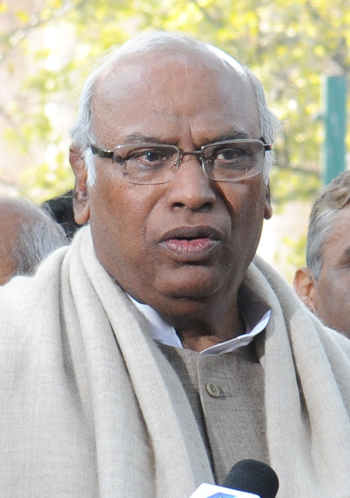
 Congress president Mallikarjun Kharge on Tuesday launched a sharp attack on the BJP-led government, accusing it of hollowing out parliamentary democracy by curbing debate, sidestepping accountability and weakening the federal balance embedded in the Constitution.
Speaking amid an acrimonious session, Kharge alleged that Prime Minister Narendra Modi had repeatedly avoided answering questions on the floor of the Lok Sabha, while the ruling Bharatiya Janata Party pressed ahead with legislation without adequate discussion. He said opposition demands for structured debate and explanations from ministers were being brushed aside, reducing Parliament to a rubber stamp.
The Congress chief argued that the health of a parliamentary system rests on open scrutiny, questioning and consent, all of which he claimed were being diluted through procedural shortcuts. According to him, truncated debates, frequent adjournments and the use of voice votes for contentious bills were undermining the spirit of representative lawmaking. Kharge said this pattern had deepened mistrust between the government and opposition benches and narrowed the space for dissenting voices.
At the centre of his criticism was what he described as a growing reluctance by the executive to submit itself to parliamentary questioning. He alleged that answers were being deflected or delegated, particularly on matters with national implications, and that this weakened the accountability chain that links the cabinet to the legislature. Kharge maintained that Parliament exists not merely to pass laws but to examine their intent, consequences and alignment with constitutional principles.
The Congress leader also accused the government of straining India’s federal framework by centralising decision-making and bypassing consultation with states. He said the passage of laws affecting state powers without detailed debate or referral to parliamentary committees eroded cooperative federalism. In his remarks, Kharge framed federalism as a constitutional safeguard rather than an administrative convenience, warning that marginalising states could have long-term consequences for governance and social cohesion.
Opposition leaders across parties echoed similar concerns in the House, pointing to repeated disruptions that have curtailed question hour and limited time for private members’ business. They argued that question hour, traditionally regarded as Parliament’s most effective accountability tool, had been shortened or suspended too often, blunting its impact. Kharge said this trend was not incidental but reflective of a broader discomfort with scrutiny.
The government, however, rejected the charges, insisting that legislative business had proceeded in line with established rules and that disruptions by opposition members had forced curtailments. BJP leaders countered that bills had been debated within the time allocated by the Business Advisory Committee and accused the opposition of creating disorder to stall governance. They said the Prime Minister had addressed the House on key occasions and that ministers remained answerable through multiple parliamentary mechanisms.
Yet Kharge maintained that the issue was not the volume of legislation passed but the quality of deliberation preceding it. He argued that parliamentary committees, which allow for expert input and bipartisan examination, were being underutilised. According to him, pushing complex bills through without committee scrutiny risked policy gaps and implementation challenges, while also depriving lawmakers of the chance to propose constructive amendments.
The Congress president placed his criticism within a broader constitutional context, saying the erosion of debate threatened the balance among the legislature, executive and judiciary. He cautioned that when Parliament’s deliberative role is weakened, governance drifts towards executive dominance, altering the democratic equilibrium envisaged by the framers of the Constitution. Kharge urged the government to view dissent as a democratic asset rather than an obstacle.