
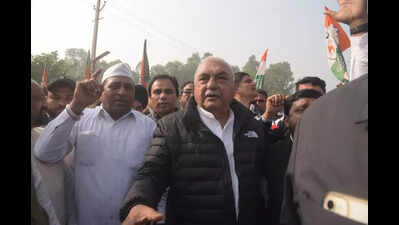
 Punjab and Haryana High Court has set aside charges against former Haryana chief minister Bhupinder Singh Hooda and The Associated Journals Limited in the 2005 Panchkula land re-allotment case, bringing significant relief to the senior Congress leader in a matter that has lingered for nearly two decades.
The court quashed the trial proceedings stemming from a vigilance case that alleged irregularities in the re-allotment of a commercial plot in Panchkula’s Sector 6 to AJL, the publisher of the National Herald newspaper. The ruling effectively nullifies the charges framed by a special court in 2020 and halts further criminal proceedings in the case unless challenged before a higher judicial forum.
The controversy dates back to 2005 when a plot originally allotted to AJL in the 1980s was resumed by the Haryana Urban Development Authority for non-construction. During Hooda’s tenure as chief minister, the land was restored to AJL after representations citing the company’s status as a newspaper publisher and earlier allotment. The vigilance bureau later alleged that the re-allotment caused a loss to the exchequer and involved procedural violations, leading to the registration of a case in 2016 under provisions related to criminal conspiracy, cheating and corruption.
Hooda has consistently maintained that the decision to restore the plot was taken in accordance with established policy and after due administrative consideration. He argued that similar relief had been granted in other cases where allottees failed to meet construction deadlines and that there was no pecuniary gain to him or any public servant. AJL, for its part, contended that it had been unfairly targeted and that the resumption of the plot in the first place was arbitrary.
The High Court, while examining the matter, assessed whether the ingredients of the alleged offences were made out and whether the continuation of criminal proceedings would amount to an abuse of process. Legal observers note that quashing of charges at this stage requires the court to be satisfied that even if the allegations are taken at face value, they do not constitute a criminal offence or lack sufficient material to proceed to trial.
The Panchkula case has had political overtones from its inception. The Bharatiya Janata Party government in Haryana had defended the vigilance probe as part of a broader drive against alleged irregularities during previous administrations. Congress leaders, however, described it as politically motivated and pointed to what they termed selective action.
The matter also intersected with wider scrutiny of AJL and its ownership structure. The company, founded during the freedom movement, came under national attention in separate proceedings relating to financial transactions and its acquisition by Young Indian, a not-for-profit company in which Congress leaders Sonia Gandhi and Rahul Gandhi hold majority stakes. Although the Panchkula case was legally distinct from those proceedings, the overlap in entities added to its political sensitivity.
Court records show that a special Central Bureau of Investigation court in Panchkula had framed charges against Hooda and others in 2020 after taking cognisance of the vigilance bureau’s findings. The accused challenged the order before the High Court, arguing that the decision to re-allot the plot was a policy matter and that criminal law was being invoked to question an administrative act.
Legal experts say the High Court’s order underscores the distinction between administrative irregularity and criminal culpability. For a charge of corruption or conspiracy to stand, there must be clear evidence of dishonest intent or undue advantage. Mere errors in procedure, they argue, do not automatically translate into criminal liability unless accompanied by proof of mala fide intent.
Political reactions followed swiftly. Congress leaders described the ruling as vindication of Hooda’s position that the case was baseless. Supporters said the judgment reinforced the principle that policy decisions taken in office cannot be criminalised without substantive evidence of wrongdoing. Leaders from the ruling party in Haryana indicated that they would examine the detailed order before deciding on further legal steps.
The case has also drawn attention to the broader issue of land allotments and urban development decisions made during periods of rapid real estate expansion. Haryana, particularly areas around Gurugram and Panchkula, witnessed significant commercial growth in the early 2000s, leading to multiple disputes over land use, licensing and compliance with development norms. Several former officials and political figures have faced inquiries linked to such decisions.
For Hooda, who served as chief minister from 2005 to 2014 and remains a prominent Congress leader in the state, the High Court’s decision removes a significant legal cloud at a time when electoral politics in Haryana remain competitive. He has been one of the principal faces of the party’s campaign in the state and has sought to project administrative experience as a counter to the ruling party’s governance record.