
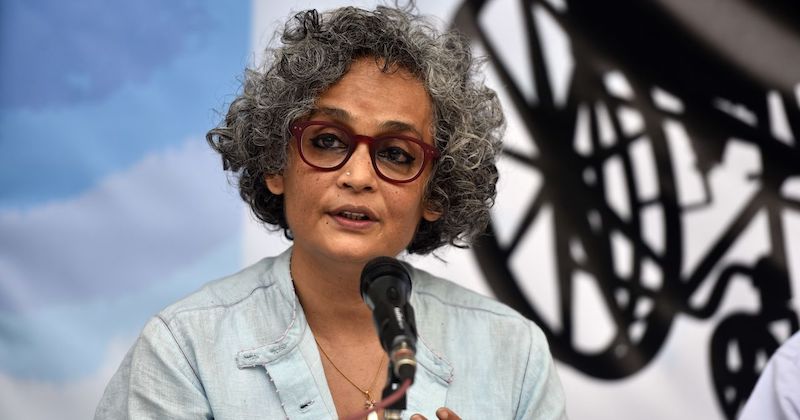
 Arundhati Roy has withdrawn from this year’s Berlin Film Festival, criticising organisers after jury president Wim Wenders made remarks about the war in Gaza that she described as deeply troubling amid mounting civilian casualties in the territory.
The Booker Prize-winning author said she would no longer participate in events linked to the festival, also known as the Berlinale, arguing that the platform had failed to acknowledge the scale of the humanitarian catastrophe unfolding in Gaza. Her decision comes at a time when cultural institutions across Europe are facing intense scrutiny over how they respond to the conflict between Israel and Hamas, which escalated sharply following the 7 October attacks and Israel’s subsequent military campaign.
Roy’s statement, shared through literary and activist networks, accused the festival leadership of offering a one-sided narrative. She said that comments made by Wenders at the opening ceremony — in which he expressed solidarity with victims of the Hamas attacks and condemned terrorism — did not sufficiently recognise the suffering of Palestinians under bombardment and blockade. Roy argued that cultural spaces should not ignore what she called a “disproportionate assault on civilians”.
Wenders, a German filmmaker known for works such as “Paris, Texas” and “Wings of Desire”, has previously described the Hamas attacks as a “terrorist crime” and expressed support for Israel’s right to defend itself. He also acknowledged the suffering of civilians on both sides, though critics contend that early public statements from festival figures focused more heavily on Israel’s losses than on the humanitarian emergency in Gaza. The Berlinale has said it stands for dialogue, artistic freedom and human dignity, emphasising that it condemns antisemitism and all forms of racism.
The row highlights the growing entanglement of international cultural events with geopolitical crises. Film festivals, literary fairs and art biennales have become arenas where political positions are aired as forcefully as artistic works. Organisers often attempt to maintain neutrality, yet artists and audiences increasingly demand explicit stances on global conflicts.
Civilian casualties in Gaza have drawn widespread concern from the United Nations and humanitarian agencies. Health authorities in the territory report tens of thousands of deaths since the conflict intensified, while Israeli officials maintain that their military operations target Hamas infrastructure and leadership. Aid organisations have warned of acute shortages of food, medicine and clean water, describing conditions as catastrophic for the enclave’s more than two million residents.
Roy has long been associated with outspoken political commentary in addition to her fiction. Since winning the Booker Prize in 1997 for “The God of Small Things”, she has written extensively on war, displacement and state violence. Her essays on Kashmir, globalisation and minority rights have drawn both acclaim and controversy. Her decision to withdraw from the Berlinale aligns with her broader pattern of public interventions on questions of justice and human rights.
Festival organisers face a delicate balancing act. Germany’s historical responsibility in combating antisemitism has shaped official responses to the Israel-Hamas conflict, with political leaders emphasising support for Israel’s security. At the same time, large demonstrations across European cities have called for a ceasefire and an end to civilian suffering in Gaza. Cultural institutions have sometimes found themselves criticised from both directions — accused either of insufficient solidarity with Israel or of suppressing pro-Palestinian voices.
Within the film community, debate has been particularly intense. Some filmmakers and actors have urged festivals to boycott Israeli state-supported productions, while others warn against collective punishment of artists based on nationality. The Berlinale has historically positioned itself as one of the more politically engaged major festivals, frequently screening films addressing migration, authoritarianism and conflict. Its programming this year includes works that explore displacement and war, though organisers have not linked specific selections to the Gaza crisis.
Roy’s withdrawal adds to a series of high-profile cultural figures taking public positions. Writers and artists from across Europe, North America and West Asia have signed open letters demanding an immediate ceasefire, while others have criticised what they see as a climate of intimidation around discussions of the conflict. Universities and galleries have also faced protests over speaker invitations and exhibition themes.