
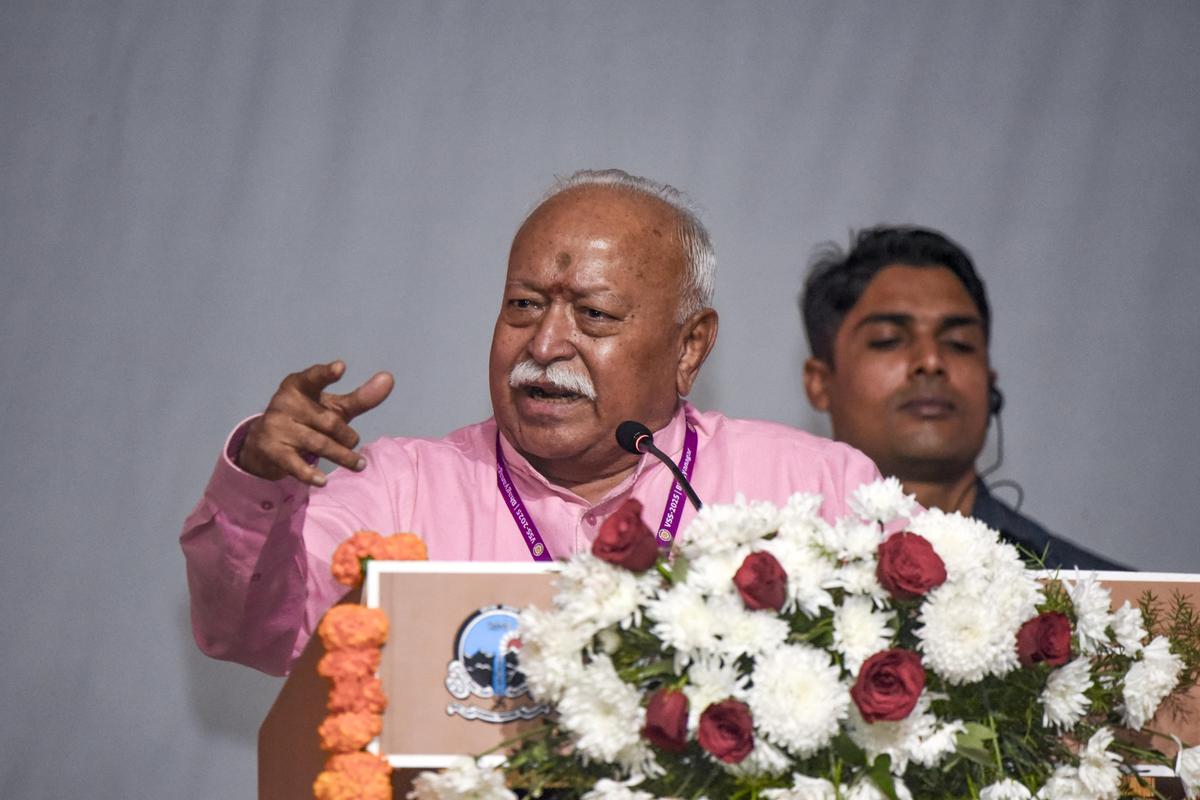
 Rashtriya Swayamsevak Sangh chief Mohan Bhagwat called for social harmony across the country on Wednesday, asking citizens to move beyond divisions rooted in language, caste and wealth, while emphasising the equal dignity of all languages and the importance of using one’s mother tongue at home.
Addressing a gathering during an organisational programme, Bhagwat said social cohesion could not be sustained if identities were reduced to markers of difference. He argued that cultural confidence, rather than competition among communities, was essential for national stability, adding that linguistic diversity should be treated as a shared inheritance rather than a source of hierarchy.
He underscored the role of mother tongues in shaping values and thought, saying families should preserve linguistic traditions within households while respecting the presence and use of other languages in public life. All languages, he said, carried equal weight and served as vehicles of knowledge, culture and social exchange.
The comments come at a time when debates over language usage, regional identity and social stratification continue to influence public discourse, education policy and electoral narratives. Bhagwat’s remarks sought to frame these debates around coexistence rather than contestation, positioning linguistic plurality as compatible with national unity.
Within the Rashtriya Swayamsevak Sangh’s ideological framework, cultural unity has long been projected as a cornerstone of social order. Bhagwat’s intervention reiterated that unity, in his view, does not require uniformity. Instead, he argued for what he described as an organic cohesion, where differences of language or custom are acknowledged without becoming fault lines.
He also addressed economic disparities, warning against allowing wealth to become another axis of social division. According to Bhagwat, social harmony weakens when economic status defines human worth, and communities must resist narratives that normalise inequality as destiny. He said mutual respect across economic classes was as critical as harmony across caste or linguistic lines.
Observers note that such statements often seek to respond to anxieties arising from rapid urbanisation, migration and the expansion of digital media, which have amplified identity-based debates. Linguistic questions, in particular, have gained prominence through discussions on education mediums, administrative communication and employment mobility.
Bhagwat did not propose specific policy prescriptions but focused on behavioural and cultural change, placing responsibility on individuals and families rather than institutions alone. He said everyday practices, including language use at home and interpersonal conduct in public spaces, collectively shape the social climate.
His emphasis on mother tongues aligns with broader discussions in academic and policy circles about cognitive development and cultural continuity. Scholars have long argued that early education in a child’s first language strengthens learning outcomes, even as multilingual proficiency remains vital in a globalised economy. Bhagwat’s remarks echoed these ideas while steering clear of privileging any single language.
The RSS chief also touched on caste, urging people to reject social discrimination in both overt and subtle forms. He said historical divisions should not dictate contemporary relationships and warned that social fragmentation ultimately undermines collective progress. The message, framed in moral rather than legal terms, appealed to social conscience over enforcement.