
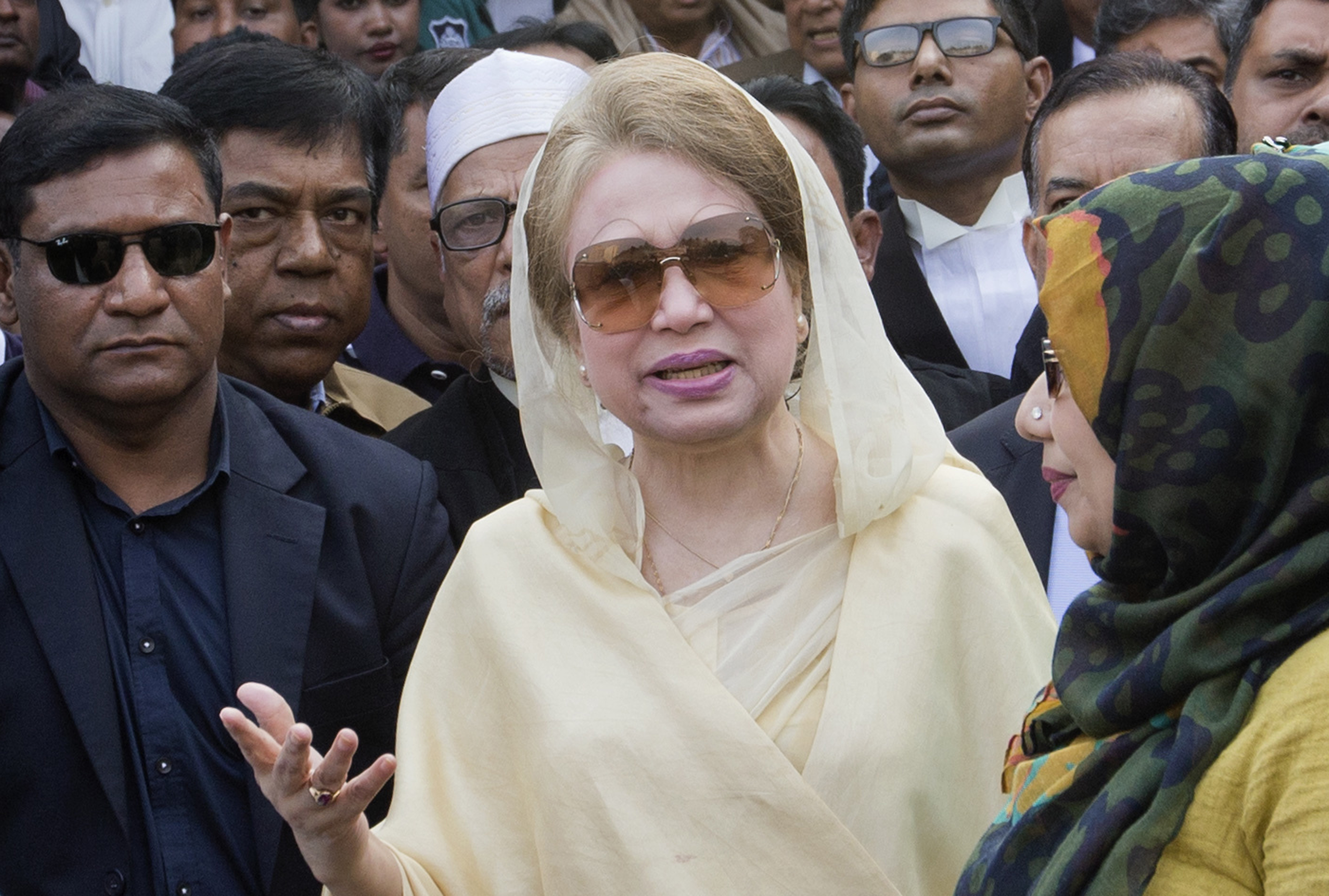
 Bangladesh’s political sphere was shaken on Tuesday as Khaleda Zia, the three-time former prime minister and long-time chairperson of the Bangladesh Nationalist Party, died at the age of 80 while undergoing treatment at Evercare Hospital in Dhaka. The party confirmed she passed away at 6:00am, surrounded by family and close aides amid escalating public attention on her health struggles and a shifting national political landscape.
 Zia had been admitted to hospital in late November with severe health complications, including heart and lung infections that developed into pneumonia, against the backdrop of enduring illnesses such as advanced liver cirrhosis, diabetes and arthritis. Medical professionals from Bangladesh, the United Kingdom, the United States, China and Australia were involved in her care, underscoring both the complexity of her condition and her family’s efforts to secure comprehensive treatment.
Her passing removes a towering yet polarising figure from Bangladeshi politics, one whose career was marked by fervent support among her followers and blistering criticism from opponents. Zia’s influence in the nation’s political evolution was profound; she broke barriers as the first woman elected to lead the government, steering Bangladesh through pivotal reforms and protracted rivalries that often defined the country’s governance.
Born Khaleda Khanam Putul in August 1945 in what was then British India, she rose from relative obscurity into the centre of power following the assassination of her husband, President Ziaur Rahman, in 1981. After his death she assumed leadership of the BNP, a party founded by her late husband, and became a key figure in the fight against military dictatorship, helping to dismantle the autocratic rule of General Hussain Muhammad Ershad.
Her first term as prime minister began after a landmark general election in 1991, a moment celebrated for restoring parliamentary democracy after years of military and authoritarian control. She later returned to power in 2001, during which her government instituted economic reforms, introduced tax changes and bolstered education access. Those achievements were juxtaposed with rising accusations of corruption and allegations of nepotism that dogged her second administration, contributing to national debates on governance and accountability.
The political rivalry between Zia and her chief adversary, Sheikh Hasina of the Awami League, became a defining feature of Bangladesh’s modern history. Known colloquially as the “battle of the Begums,” this protracted contest for political supremacy drew sharp divisions within society, often igniting protests and street confrontations.
The rivalry was further complicated by legal battles and incarceration. Zia was convicted on corruption charges in 2018, a verdict she and her supporters described as politically motivated. Her imprisonment and subsequent health deterioration sparked debate across domestic and international arenas over political justice and human rights. In early 2025, the Supreme Court acquitted her in the remaining corruption case, potentially clearing a path for renewed political engagement.
Zia’s personal narrative was inseparable from this larger political drama. Her requests to travel abroad for treatment were repeatedly denied by the previous administration led by Hasina, with approvals only granted under an interim government earlier this year. She travelled to London for care before returning to Dhaka in May.
Her death has triggered an outpouring of tributes and mourning across Bangladesh, with party leaders and supporters lauding her as a stalwart of democratic struggle and criticising the toll that political contestation and health neglect took on her final years. At the same time, analysts note that controversies over her leadership style, alliances with Islamist parties and governance record remain deeply contested in public discourse.
Zia is survived by her eldest son, Tarique Rahman, who serves as the BNP’s acting chairman, his wife Zobaida Rahman, and their daughter Zaima Rahman. Her younger son, Arafat Rahman Koko, predeceased her. Tarique’s return from exile earlier this month after nearly two decades adds another layer of political significance to her passing, as Bangladesh prepares for national elections scheduled for February 2026.