
 West Bengal Chief Minister Mamata Banerjee sharpened her attack on the Bharatiya Janata Party on Thursday after the Supreme Court delivered a stinging rebuke to the state administration over the alleged gherao of judicial officers in Malda, turning a law-and-order controversy into a larger battle over the conduct of the Assembly election campaign.
 Addressing a rally in Sagardighi in Murshidabad district, Banerjee said the BJP’s wider objective was to derail the Bengal election and create conditions for President’s Rule. Her remarks came hours after the apex court reacted with visible anger to reports that seven judicial officers, including three women, were surrounded for hours while handling objections linked to the electoral roll exercise in Malda’s Kaliachak area.
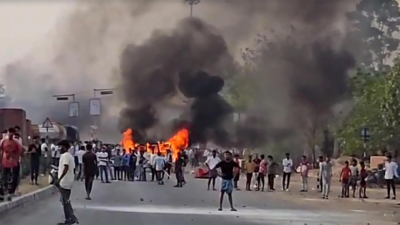
The Supreme Court, led by Chief Justice of India Surya Kant alongside Justices Joymalya Bagchi and Vipul Pancholi, treated the episode as far more than a local disruption. According to accounts placed before the bench, the officers were stopped from leaving the Block Development Officer’s office from about 3.30 pm on Wednesday, with senior state officials either unreachable or slow to respond. The court said food and water were not supplied to the officers during the standoff and noted that their vehicles were attacked with stones and sticks after they were finally evacuated after midnight.
In unusually severe language, the bench described the affair as a brazen challenge to the authority of the court and a calculated move that risked intimidating judicial officers entrusted with election-related work. It issued notices to the chief secretary, the director general of police, the district magistrate and the superintendent of police, asking why action should not follow. The court also directed the Election Commission to requisition central forces to protect judicial officers engaged in the Special Intensive Revision process and to assess any threat to their families.
That judicial intervention has raised the stakes in an already combustible pre-election climate. Bengal’s voter-list revision has become one of the most fiercely contested issues of the campaign, with Banerjee and the Trinamool Congress alleging that large numbers of legitimate names were removed, while the BJP has argued that the process is necessary to clean up the rolls. The legal dispute has pulled the Supreme Court, the Election Commission, the Calcutta High Court and the state government into overlapping institutional conflict just as campaigning gathers pace.
Banerjee sought to turn the Malda embarrassment back on her opponents. At Sagardighi, she alleged that the BJP wanted to provoke instability, stop the poll process and justify direct central intervention in the state. She also questioned the Election Commission’s ability to protect officers deployed under the revision exercise, arguing that responsibility for their security could not be separated from the way the process itself had been managed.
The BJP has answered with the opposite charge, saying the Malda incident exposed administrative collapse under Trinamool Congress rule and proved that officials working on the electoral process could not function freely. That line of attack fits a broader opposition effort to present the state as politically overheated and institutionally compromised. The court’s own oral remarks, including its observation that Bengal appeared deeply polarised and that “everyone speaks in political language”, gave fresh ammunition to critics of the government even as Banerjee tried to frame the episode as part of a political conspiracy against her.
At the centre of the dispute is not only security, but legitimacy. Judicial officers were brought into the revision exercise to adjudicate claims and objections with a degree of neutrality. The allegation that even such officers could be blocked by protesters has alarmed the court because it cuts to the enforceability of the electoral process itself. The bench’s insistence on central-force deployment suggests it is no longer willing to rely solely on state machinery in sensitive pockets.
Malda carries political and symbolic weight. The district has long reflected Bengal’s sharper social and electoral cleavages, and Kaliachak has drawn official attention before over law-and-order concerns. That the confrontation occurred there, amid anger over deleted voter names, has made the episode a flashpoint in the argument over whether the revision exercise is an administrative correction or a politically fraught intervention with consequences for representation and turnout.