
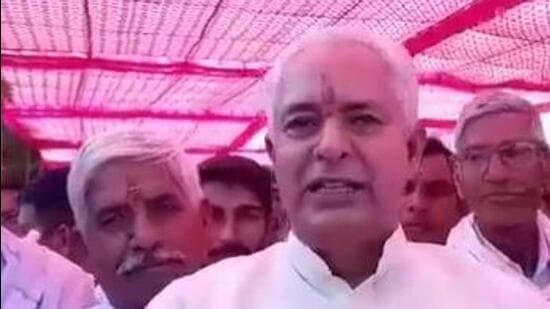
 Political tensions sharpened after Bharatiya Janata Party spokesperson CR Kesavan accused Maharashtra Congress MLA Nana Patole of delivering what he termed a “grievous insult” to Hindu sentiments by drawing a comparison between Leader of the Opposition in the Lok Sabha Rahul Gandhi and Lord Ram. The remarks, made during a public interaction, triggered swift condemnation from the BJP, which framed the episode as part of a broader pattern of political rhetoric intruding into matters of faith.
Patole said Gandhi was “fighting for justice” and likened that effort to Lord Ram’s role in standing up for the oppressed. The analogy drew immediate pushback. In a post on X, Kesavan questioned the appropriateness of invoking a revered religious figure in contemporary political debate and asked Patole to explain why Gandhi has not visited the Ayodhya Ram Temple, a shrine of immense significance to Hindus. The BJP leader argued that such comparisons risk trivialising faith while serving partisan aims.
The Congress leader’s remarks arrived amid an already charged political climate in Maharashtra and at the national level, where religion, identity and electoral positioning frequently intersect. BJP leaders said the comparison crossed a line by equating a living political figure with a deity central to Hindu belief, asserting that faith should not be instrumentalised to score political points. Party functionaries maintained that reverence for religious icons demands restraint and sensitivity, especially from elected representatives.
Congress leaders defended Patole’s comments as metaphorical rather than theological, insisting that the statement was intended to highlight Gandhi’s political stance on justice and constitutional values rather than draw a literal equivalence. Supporters within the party said the analogy echoed a long tradition of using moral narratives from epics to convey ideas of righteousness in public life. They accused the BJP of amplifying the issue to divert attention from substantive policy debates and to mobilise sentiment ahead of elections.
The exchange underlined how references to religion continue to function as potent political accelerants. Analysts note that Lord Ram occupies a unique place in public discourse, particularly after the inauguration of the Ram Temple in Ayodhya, which has heightened sensitivities around invocations of the deity. Any perceived slight or politicisation tends to draw swift reactions, often magnified by social media platforms where statements circulate rapidly and provoke polarised responses.
Kesavan’s challenge on Gandhi’s absence from the Ayodhya temple touched on a recurring line of attack by the BJP, which has repeatedly questioned the Congress leader’s engagement with Hindu religious institutions. Congress figures have countered that personal faith choices should not be used as political litmus tests and that secular leadership does not require public displays of religiosity. They argue that constitutional roles demand respect for all faiths rather than performative symbolism.
The controversy also reflects the BJP’s broader strategy of positioning itself as a guardian of Hindu interests while casting opponents as insensitive or opportunistic on matters of belief. Congress leaders, for their part, maintain that the party’s emphasis remains on social justice, economic issues and institutional accountability, and that religious metaphors should be read in that context rather than as doctrinal claims.