
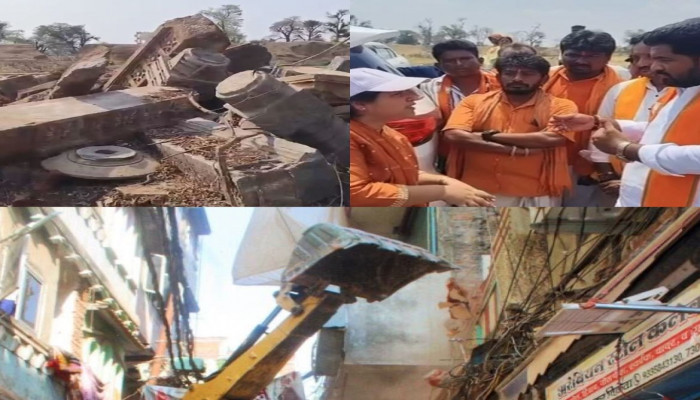
 Public anger mounted in Warangal after an 800-year-old Kakatiya-era Shiva temple at Ashok Nagar village in Khanapur mandal was demolished during land-clearing work for a proposed government residential school, drawing intervention from the Union Ministry of Culture and demands for legal action against officials and contractors involved.
The shrine, located within the old Kota Katta mud fort area, was believed to date back to the 13th century and had drawn the attention of historians because of a rare seven-line Telugu inscription dated February 1231 AD. The inscription referred to Kakatiya ruler Ganapati Deva, whose reign marked one of the most significant phases of temple construction, irrigation expansion and military consolidation in the Deccan.
Villagers alleged that heavy machinery was used to raze the structure while nearly 30 acres were being cleared for an integrated residential school project. The demolition triggered protests from residents, heritage activists and historians, who said the structure should have been surveyed, fenced and conserved before any development work was allowed to proceed. Local officials have denied any deliberate attempt to destroy a heritage monument, while the district administration has sought a report on how the demolition took place.
Warangal Collector Dr Satya Sharada said the temple was not listed in the records of the Archaeology department, but acknowledged the need to preserve heritage structures. That position has not satisfied campaigners, who argue that absence from a protected list cannot be treated as permission to erase a medieval monument, particularly in a district whose identity is closely tied to Kakatiya architecture.
The issue reached the National Monuments Authority after rights lawyer Immaneni Rama Rao filed a complaint seeking action against those responsible. Proceedings were then initiated by the Union Ministry of Culture and the Archaeology department. The complaint also raised questions over whether the safeguards required under the Telangana Heritage Act had been followed before machinery entered the site.
Historians said the demolished temple had been documented by the heritage department in 1965 and formed part of a wider historical landscape linked to the Kakatiya period. They said the structure’s inscriptional evidence made it especially valuable, as dated stone records from the period help establish land grants, religious patronage, political authority and settlement history. Once such material is disturbed or broken, much of its evidentiary value can be lost permanently.
The controversy has placed the Telangana government’s school infrastructure push under scrutiny. The Young India Integrated Residential School programme has been projected as a major investment in public education, aimed at providing better residential facilities, classrooms and access to students from disadvantaged backgrounds. The Warangal episode, however, has sharpened the debate over whether public works departments and local contractors have adequate instructions to identify and protect heritage assets before construction begins.
Warangal’s heritage status adds weight to the criticism. The region was once the power centre of the Kakatiya dynasty, whose monuments include the Warangal Fort, the Kakatiya Kala Thoranam and the Thousand Pillar Temple at Hanamkonda. The Ramappa Temple at Palampet, built under Kakatiya patronage, was inscribed on the UNESCO World Heritage List in 2021, reinforcing the region’s archaeological importance.
The destruction of a smaller shrine has therefore raised a larger governance question: how many unprotected monuments remain vulnerable because they are not formally listed, fenced or mapped. Heritage activists say the absence of a live inventory allows village temples, inscriptions, wells, tanks, forts and memorial stones to disappear during road works, real estate projects and public infrastructure expansion.
Officials now face pressure to identify who authorised the land-clearing work, whether the contractor was informed of the structure’s historical value, and why no archaeological inspection was conducted before demolition. Campaigners have sought recovery of stone fragments, inscription panels and sculptural remains from the site so that at least partial documentation and reconstruction can be attempted.